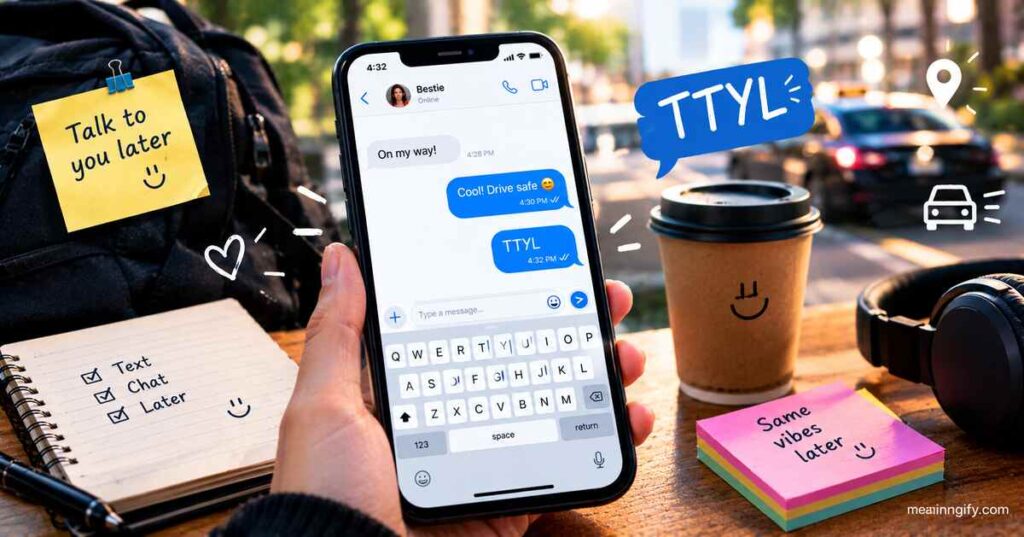

TTYL Mean, You’re mid-conversation, your ride shows up, and instead of typing out a full goodbye, you send one word: “TTYL.” It’s quick, it’s friendly, and almost everyone who’s ever texted knows exactly what it means.
This guide covers what TTYL stands for, where it came from, how to use it naturally, and the small mistakes that can make it fall flat.
Table of Contents
- Understanding the Meaning of TTYL
- The History and Origins of TTYL
- How to Use TTYL in Everyday Conversations
- Examples of TTYL in Real-Life Texts and Chats
- Common Mistakes to Avoid When Using TTYL
- Why TTYL Still Matters in Today’s Digital World
- FAQs
- Conclusion
Understanding the Meaning of TTYL
TTYL stands for “talk to you later.” It’s a casual sign-off used to end a text, chat, or online conversation without sounding abrupt.
Think of it as a digital wave goodbye. It doesn’t promise an exact time to reconnect, it just signals that the conversation is pausing, not ending for good.
Read More : YOLO Meaning: What Does YOLO Mean in Slang?
What TTYL Really Communicate
TTYL does more than say “bye.” It carries a specific, friendly tone:
- It’s casual. TTYL fits texts between friends, not formal messages.
- It’s open-ended. Unlike “see you at 5,” TTYL doesn’t commit to a time.
- It softens the exit. Ending a chat with TTYL feels warmer than just going silent.
Common Variations
You’ll see TTYL written a few different ways, and all of them mean the same thing:
| Variation | Meaning |
|---|---|
| TTYL | Talk to you later |
| ttyl | Talk to you later (lowercase, same meaning) |
| TTYL8R | Talk to you later (playful spelling) |
| TTYL2 | Talk to you later too |
The History and Origins of TTYL
TTYL feels like a product of smartphone texting, but its story starts much earlier than that.
From Chatrooms to Cell Phones
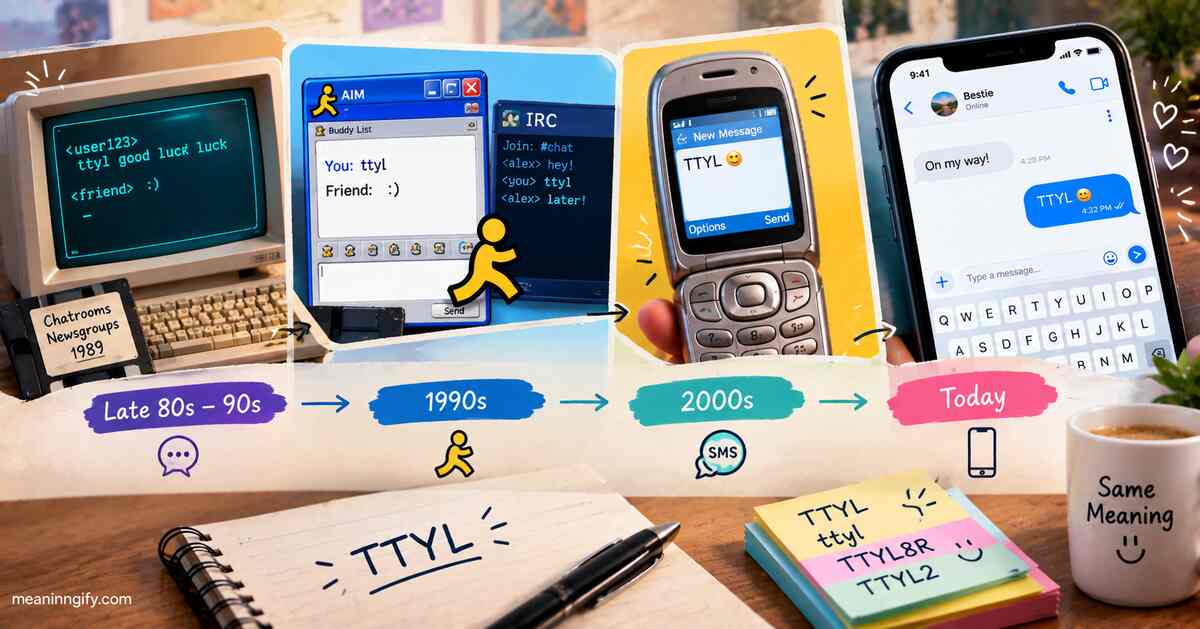
Merriam-Webster traces TTYL and similar internet shorthand to a period of widespread abbreviation use stretching back into the 1980s and 1990s, when early online communities were already trading acronyms like this one. One newsgroup post from 1989, cited by Merriam-Webster, shows someone signing off with “ttyl good luck”, proof the abbreviation was already in casual use decades before smartphones existed.
Through the 1990s, platforms like AOL Instant Messenger (AIM) and Internet Relay Chat (IRC) turned this kind of shorthand into an everyday habit. These early chat tools set strict limits on how fast people could type and how much space a message could take up, so quick sign-offs like TTYL, BRB, and GTG became second nature.
The SMS Era
When mobile texting took off in the 2000s, character limits on SMS messages gave TTYL a second wind. Every letter counted, and a three-letter goodbye was far more efficient than typing “talk to you later” on a numeric keypad.
TTYL Today
Smartphones removed the character limits that made TTYL useful, but the habit stuck. It’s now used out of familiarity and tone, not necessity, the same way people still say “cc” on an email even though nobody’s using carbon paper.
Quick Timeline
- Late 1980s–1990s : Early chatroom and newsgroup users adopt TTYL as shorthand.
- 1990s : AIM and IRC popularize it as a standard sign-off.
- 2000s : SMS character limits push TTYL into mainstream texting.
- Today : TTYL survives as a habit and a tone-setter, not a technical necessity.
How to Use TTYL in Everyday Conversations
TTYL is easy to use, but a few small habits make it feel natural instead of stiff.
Simple Steps
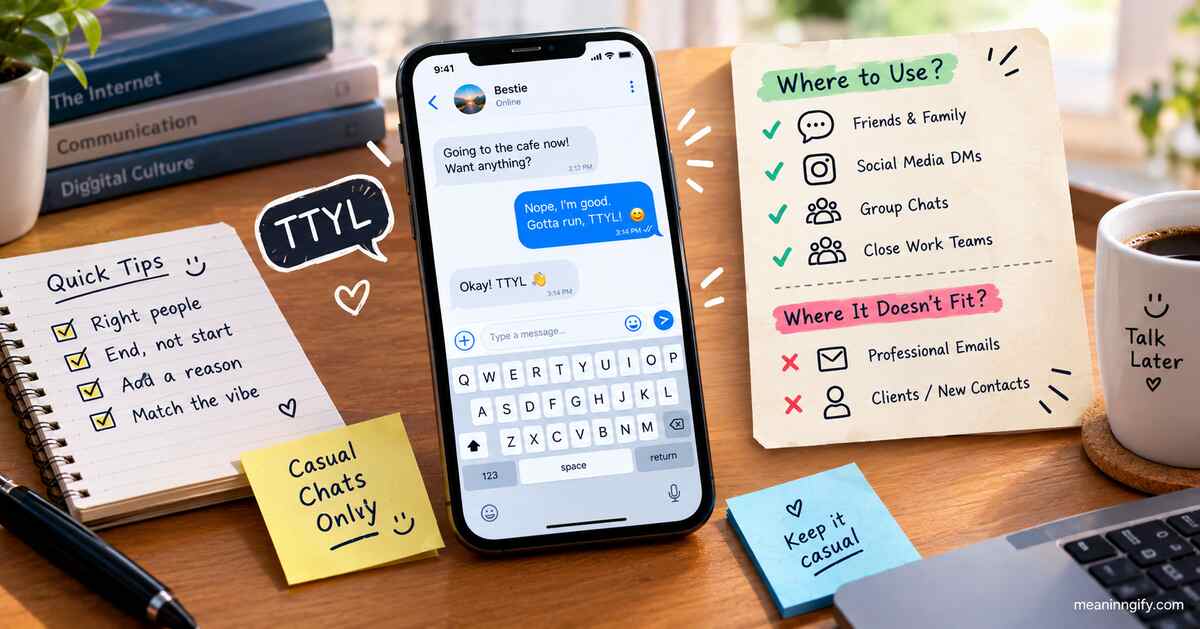
- Save it for casual chats. TTYL belongs in texts with friends, family, or close coworkers.
- Use it to end a conversation, not start one. It signals you’re stepping away, not opening a new topic.
- Pair it with a short reason (optional). “Gotta run, TTYL” reads more naturally than a bare “TTYL.”
- Match the energy of the chat. If the conversation has been playful, TTYL fits right in.
Where TTYL Fits and Where It Doesn’t
| Setting | Use TTYL? | Why |
|---|---|---|
| Texting friends or family | ✅ Yes | Casual and expected |
| Social media DMs | ✅ Yes | Matches the informal tone |
| Group chats | ✅ Yes | Quick, friendly exit |
| Workplace chat with close teammates | ⚠️ Depends | Fine in relaxed teams |
| Professional emails | ❌ No | Too casual for formal writing |
| Messages to clients or new contacts | ❌ No | Can come across as unprofessional |
Examples of TTYL in Real-Life Texts and Chats
Seeing TTYL in real conversations makes it easier to use naturally.
Ending a call to run an errand
Jordan: Heading out to grab groceries, TTYL! Priya: Sounds good, have fun.
Wrapping up a long group chat
Sam: This has been fun but I gotta hop off. TTYL everyone.
Pausing mid-conversation
Alex: My battery’s about to die lol, TTYL Chris: No worries, talk soon.
A quick, friendly sign-off
“Class is starting, TTYL!”
Ending a work chat between teammates
“Heading into a meeting, TTYL if anything comes up.”
In every example, TTYL closes the conversation without sounding cold or final.
Common Mistakes to Avoid When Using TTYL
TTYL is simple, but a few habits can make it land wrong.
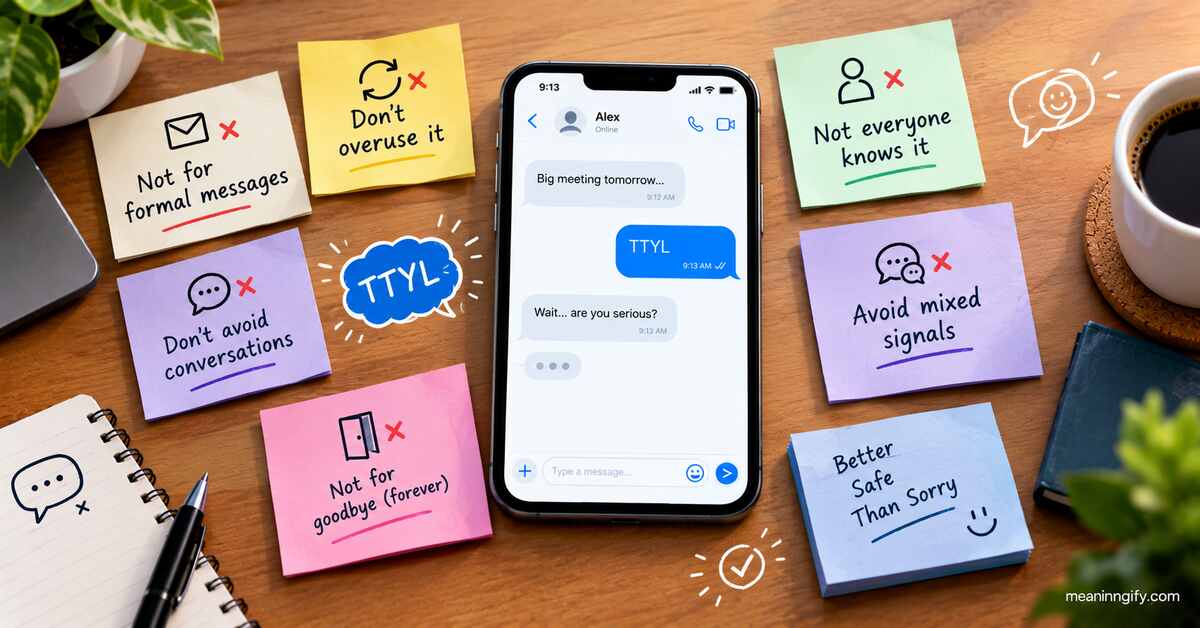
- Using it in formal messages. Emails to clients, cover letters, and professional reports need a full phrase instead.
- Using it to avoid a conversation. Sending TTYL and then not responding for days can feel dismissive.
- Overusing it. Ending every single message with TTYL, even mid-conversation, can feel repetitive or confusing.
- Using it when you mean “goodbye for good.” TTYL implies you’ll reconnect. If the conversation is actually over, a clearer sign-off is more honest.
- Assuming everyone reads it the same way. Some older or less online contacts may not immediately recognize it, spelling it out avoids confusion.
- Pairing it with mixed signals. Following TTYL with more questions defeats the purpose of a sign-off.
Why TTYL Still Matters in Today’s Digital World
Plenty of early internet acronyms have faded. TTYL hasn’t, and there are clear reasons why.
- It fills a real gap. Texting lacks tone of voice, and TTYL softens an exit that could otherwise feel abrupt.
- It’s instantly recognizable. Few abbreviations are as widely understood across age groups.
- It works across every platform. From SMS to WhatsApp to Discord, TTYL never needed updating.
- It signals warmth, not distance. Ending with TTYL feels friendlier than simply going quiet.
Even as new slang comes and goes, TTYL remains one of the most dependable ways to close a casual conversation.
FAQs
What does TTYL mean in texting?
TTYL means “talk to you later.” It’s a casual way to end a text conversation without a firm plan to reconnect.
Where did TTYL come from?
TTYL started in early internet chatrooms and newsgroups in the late 1980s and 1990s, and later spread through AIM, IRC, and SMS texting.
Is TTYL still used in 2026?
Yes. TTYL remains common in texts, DMs, and casual chats, even though character limits no longer make it necessary.
Is TTYL rude?
No. TTYL is a friendly, casual sign-off, but disappearing for a long time after sending it can come across as dismissive.
Can I use TTYL in work messages?
Only in casual chats with close teammates. Skip it in emails to clients or anyone outside your immediate team.
What’s the difference between TTYL and BRB?
TTYL means you’re ending the conversation for now. BRB (“be right back”) means you’re stepping away briefly and coming right back.
Does TTYL mean the conversation is over for good?
No. TTYL implies you’ll talk again later, just without a set time, it’s not meant as a permanent goodbye.
Conclusion
TTYL means “talk to you later,” and it’s stuck around since the earliest days of online chatrooms because it solves a simple problem: how to leave a conversation without sounding cold. It moved from newsgroups to AIM to SMS to every messaging app in use today, and it still works the same way it always has.
Use it in casual texts and chats, skip it in formal writing, and it’ll keep doing exactly what it was built for; a quick, warm way to say “not gone, just away.”