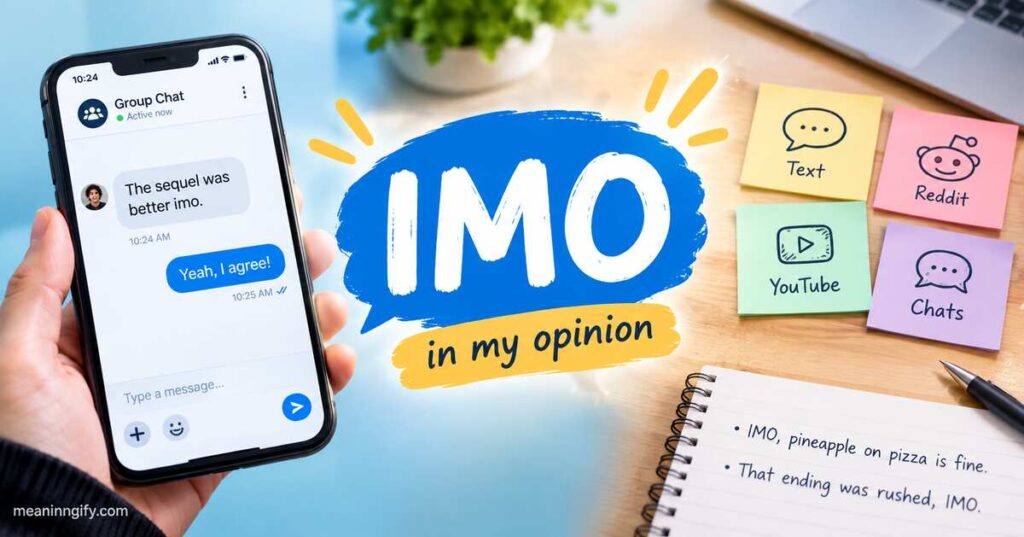

You’ve seen it in group chats, Reddit threads, and YouTube comments: “IMO, the sequel was better.” Three letters, and the whole sentence suddenly sounds like a friendly take instead of a fact.
So what does IMO mean, where did it come from, and how do you use it without sounding awkward? This guide covers the meaning, the history, real examples, common mistakes, and how IMO stacks up against IMHO and TBH.
Table of Contents
- The Basic Meaning of IMO
- Where IMO Came From and Why It Stuck Around
- How and When to Use IMO the Right Way
- Real-Life Examples of IMO in Texts and Online
- Common Mistakes People Make With IMO
- IMO vs. IMHO vs. TBH ; What’s the Difference?
- Why IMO Is Still Relevant in 2026
- FAQs
- Conclusion
The Basic Meaning of IMO
IMO stands for “in my opinion.” It’s an internet slang initialism that tells the reader you’re sharing a personal viewpoint, not stating a fact.
You’ll find it in text messages, social media comments, forums, and chat apps. It usually sits at the start or end of a sentence:
- IMO, pineapple on pizza is fine.
- That ending was rushed, IMO.
Other Things IMO Can Stand For
Context matters, because “IMO” isn’t always slang. Outside of texting, it can refer to:
- International Maritime Organization: the United Nations agency that regulates shipping safety and marine pollution.
- International Mathematical Olympiad: the annual competition for pre-university students, first held in Romania in 1959.
- imo: a video calling and messaging app.
- Imo State: a state in Nigeria.
If the conversation is casual and someone is giving a take, it means “in my opinion.” Nine times out of ten, that’s the one you need.
Read More : What Does “ISTG” Mean in Text? Complete Guide to Its Meaning, Usage, and Contexts
Where IMO Came From and Why It Stuck Around
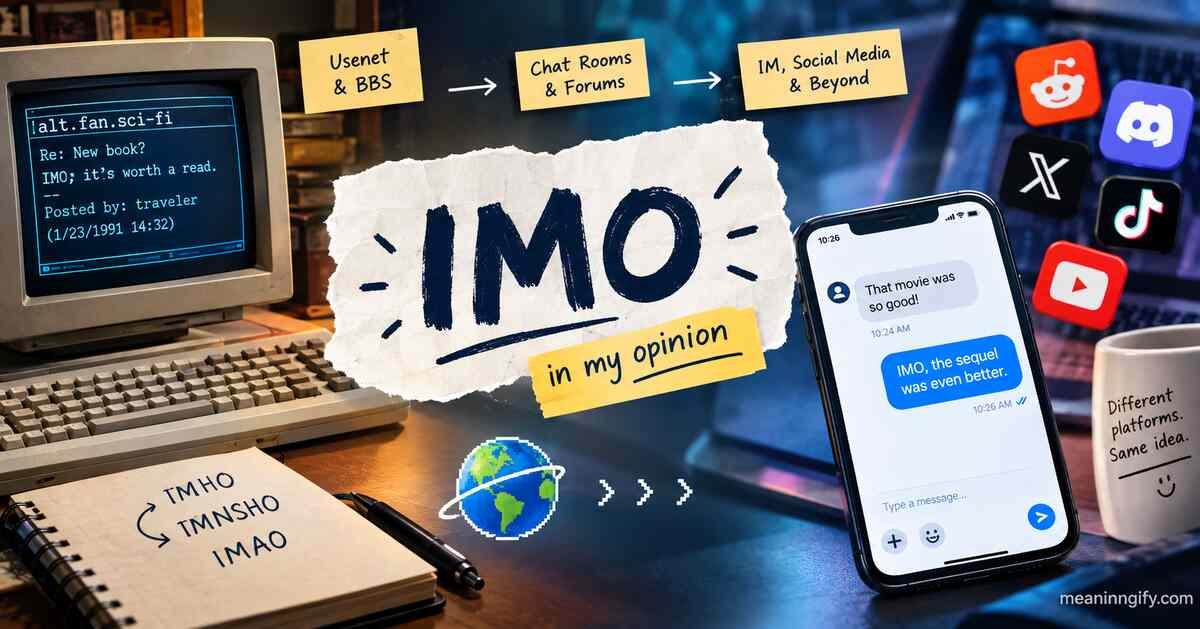
The phrase “in my opinion” has been around for centuries. The abbreviation comes from early online life.
Most sources trace IMO to the Usenet newsgroups, bulletin board systems, and chat rooms of the 1980s and early 1990s. Screens were small, connections were slow, and typing shortcuts saved time. Nobody can point to one documented “first” IMO, so treat any exact date you see online with caution.
There’s better evidence for its cousin. Wiktionary lists IMHO in sources dating back to 1986, and the same online debate culture produced jokey spin-offs like IMNSHO (“in my not-so-humble opinion”) and IMAO (“in my arrogant opinion”).
Why It Survived When Other Slang Died
Plenty of slang fades in a year. IMO didn’t, for three reasons:
- It solves a real problem. Text has no tone of voice. IMO signals “this is my view” in three letters.
- It softens disagreement. A hot take with IMO attached feels less like a challenge.
- It moved with every platform. Forums, instant messengers, Twitter, Discord, TikTok comments. IMO went along for the ride.
How and When to Use IMO the Right Way
Using IMO is easy. Using it well takes a little judgment.
Simple Steps
- State your opinion. Make sure you’re actually sharing a view, not a fact.
- Place IMO at the start or end. “IMO, this song is overrated” and “This song is overrated, IMO” both work.
- Capitalize it. All caps (IMO) looks intentional. Lowercase “imo” is fine in casual chats.
- Match the other person. If nobody in the thread uses abbreviations, you can skip it.
Where IMO Fits and Where It Doesn’t
| Setting | Use IMO? | Why |
|---|---|---|
| Texting friends | ✅ Yes | Casual by nature |
| Social media comments | ✅ Yes | Fast, informal, expected |
| Forums and Reddit | ✅ Yes | Its original home |
| Workplace chat (Slack, Teams) | ⚠️ Depends | Fine in relaxed teams, risky with clients |
| Emails to clients or bosses | ❌ No | Too informal |
| Essays, reports, cover letters | ❌ No | Slang weakens formal writing |
Formal Alternatives
When IMO feels too casual, swap in one of these:
- In my view
- From my perspective
- I believe
- It seems to me that
- Personally, I think
Real-Life Examples of IMO in Texts and Online
Seeing IMO in context makes it stick. Here are a few realistic scenarios.
Group chat about weekend plans
Sara: Movie or bowling tonight?
Dan: IMO bowling. We always pick a movie.
Sara: Fair point.
Reddit comment on a gaming thread
“The first level is the best one, IMO. Everything after it feels like filler.”
Friend asking for advice
Mia: Should I cut bangs?
Lena: IMO you’d look great, but only if you’re ready to style them daily.
Workplace Slack message
“IMO we should test the landing page before launch, but I’m happy to hear other ideas.”
Product review
“Battery life is decent, but the screen is too dim outdoors IMO.”
Notice the pattern. In every case, IMO frames the sentence as a viewpoint and leaves room for the other person to disagree.
Common Mistakes People Make With IMO
Small slip-ups can make IMO backfire. Watch for these.
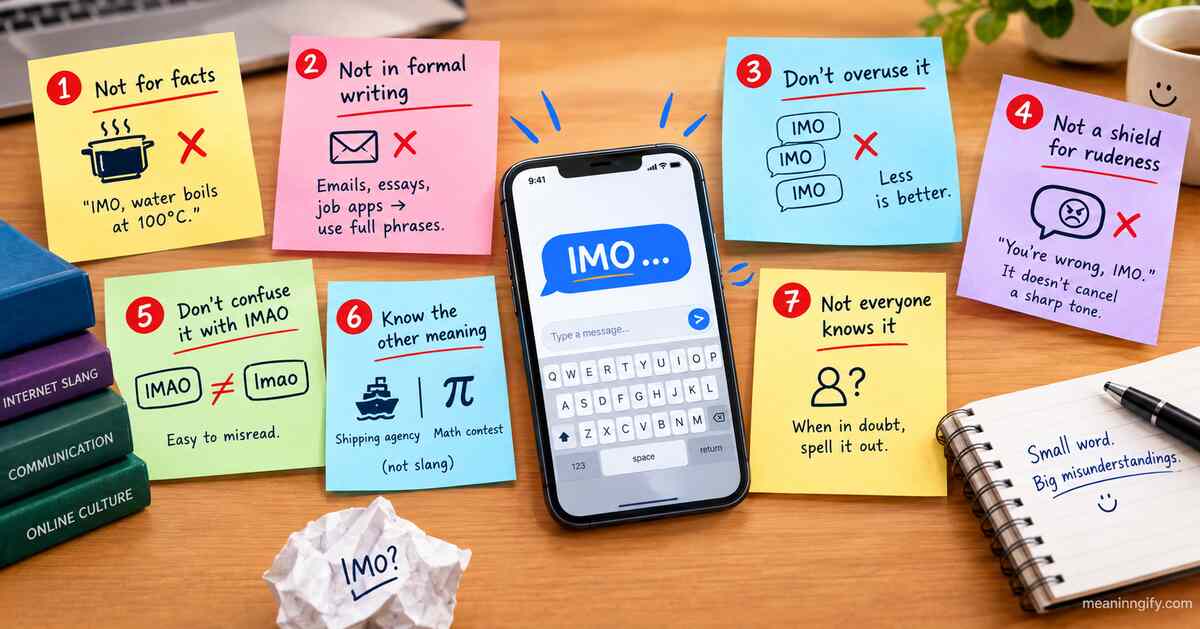
- Using it for facts. “IMO, water boils at 100°C” makes no sense. Save it for opinions.
- Using it in formal writing. Emails to clients, school essays, and job applications need full phrases.
- Overusing it. If every sentence ends with IMO, your message reads as nervous or unsure.
- Using it as a shield for rude comments. “You’re wrong, IMO” isn’t polite. Adding IMO doesn’t cancel a sharp tone. Some readers hear it as sass.
- Confusing it with IMAO. IMAO (“in my arrogant opinion”) is easy to misread as “lmao,” because a capital I looks a lot like a lowercase L.
- Mixing up meanings. In a shipping report or a math competition, IMO is an organization or contest, not slang.
- Assuming everyone knows it. Some older readers may not recognize it. When in doubt, write it out.
IMO vs IMHO vs TBH ; What’s the Difference?
These abbreviations look similar, but they do different jobs.
| Abbreviation | Stands For | What It Signals | Example |
|---|---|---|---|
| IMO | In my opinion | A plain personal view | IMO, the book beats the movie. |
| IMHO | In my humble opinion | Same view, with modesty (or irony) | IMHO, this is the best pizza in town. |
| IMNSHO | In my not-so-humble opinion | A confident, often joking take | IMNSHO, I’m the best driver here. |
| TBH | To be honest | Bluntness or a candid admission | TBH, I didn’t like the ending. |
| IIRC | If I recall correctly | Uncertainty about a fact | IIRC, the store closes at nine. |
The Quick Rule
- IMO and IMHO are interchangeable for most people. IMHO just sounds a touch more modest, and that modesty is often ironic.
- TBH is about honesty, not opinion. It often introduces something blunt.
- IIRC deals with memory, not opinion.
Some people read the “H” in IMHO as “honest” rather than “humble.” The “humble” version is the older, documented one, but both are widely understood.

FAQs
What does IMO mean in text?
IMO means “in my opinion.” It tells the reader that the sentence is your personal view, not a fact.
What does IMO mean in slang?
In slang, IMO is shorthand for “in my opinion,” used in texts, chats, and social media comments.
Is IMO rude?
No. IMO is neutral and often softens a statement, though a harsh sentence stays harsh even with IMO attached.
What is the difference between IMO and IMHO?
IMHO means “in my humble opinion.” It carries the same meaning as IMO with a slightly more modest (or sarcastic) tone.
Can I use IMO in emails?
Only in casual emails to people you know well. For work or formal emails, write “in my view” or “I believe.”
Should IMO be capitalized?
All caps (IMO) is the standard form. Lowercase “imo” is common in quick, casual chats.
What does IMO stand for besides “in my opinion”?
It can also mean International Maritime Organization, International Mathematical Olympiad, or the imo messaging app.
Where did IMO come from?
It grew out of early text-based online communities like Usenet and chat rooms in the 1980s and 1990s.
Conclusion
IMO means “in my opinion,” and it’s one of the most durable pieces of internet shorthand around. It began in early online forums, spread through every new platform, and still earns its place because it does something simple: it separates your take from a fact.
Use it in casual chats, comments, and friendly debates. Skip it in formal emails and reports, and don’t lean on it so hard that every sentence sounds unsure. Get that balance right, and three little letters will keep your opinions clear, polite, and easy to discuss.
Have a slang term you keep seeing but can’t decode? Check our other internet slang guides and decode it in seconds.