

IK Means , You’re mid-conversation, texting a friend, scrolling through TikTok comments, or reading Instagram DMs — and there it is again: “IK.” Two letters. Zero explanation. And somehow, everyone around you seems to understand it perfectly except you.
IK Mean, If you’ve ever paused and thought, “Wait, what does IK actually mean?” — you’re in very good company. This tiny abbreviation is one of the most searched internet slang terms online, and for good reason: while its core meaning is simple, its emotional weight can shift dramatically depending on how, where, and by whom it’s used.
This is the most complete guide to “IK” you’ll find anywhere. We’ll go beyond just the definition and explore the history, tone, platform-specific use, variations, misconceptions, psychology, real conversation examples, professional context, technical meanings, and how it compares to similar slang. By the end, you’ll use “IK” like a digital native — and you’ll understand it when others use it too.
The Basic Answer: What Does “IK” Mean in Text?
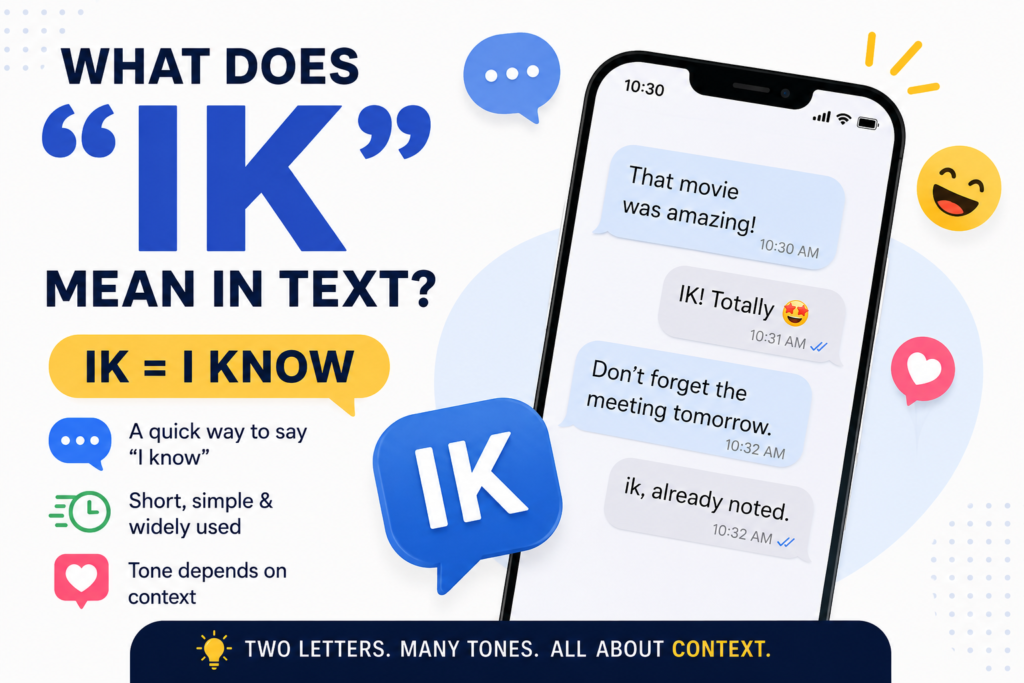
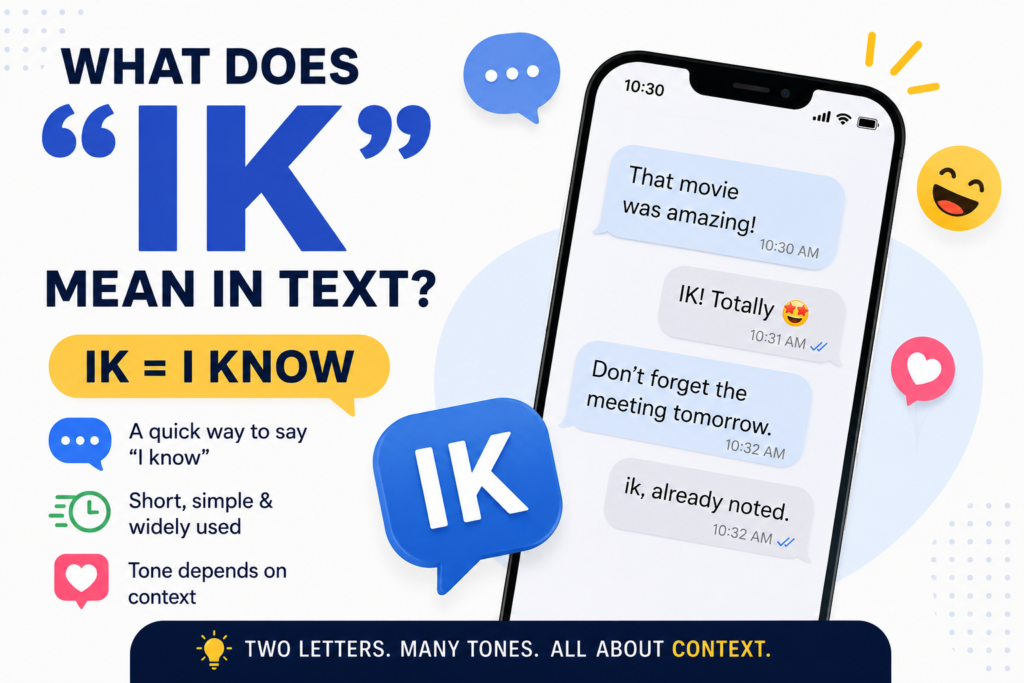
“IK” stands for “I know.”
IK Mean, At its core, it’s a two-letter shortcut for one of the most common acknowledgments in human communication. When someone tells you something you’re already aware of, agree with, or have already experienced, “IK” lets you confirm that instantly — without typing out a full sentence.
Simple example:
Friend: “That show gets so much better in season 2.” You: “IK, I’ve already watched the whole thing.”
That’s the foundation. But the real story of “IK” is much more layered than a simple definition suggests.
The Origin and History of “IK”
To understand why “IK” exists, you need to understand the digital world it was born into.
The SMS Era (Late 1990s – Early 2000s)
IK Mean, Before smartphones, texting meant using a physical keypad where each button cycled through multiple letters. Typing “I know” required pressing several keys multiple times just to get two words. On top of that, many carriers charged per character or per message, making brevity a practical — and financial — necessity.
This environment was a breeding ground for abbreviations. Classics like “LOL” (laugh out loud), “BRB” (be right back), “OMG” (oh my god), and “IDK” (I don’t know) were all born from this same era of compressed, efficient communication. “IK” followed naturally as a condensed version of the already-common phrase “I know.”
The Instant Messaging Boom (Mid-2000s)
IK Mean,Platforms like AOL Instant Messenger (AIM), MSN Messenger, and Yahoo Chat turned texting slang into a cultural language. Millions of teenagers — now known as Millennials — grew up typing “IK,” “lol,” “brb,” and “ttyl” as their primary mode of written communication. These abbreviations weren’t just shortcuts; they became social signals that said, “I’m fluent in this digital culture.”
The Social Media Explosion (2010s – Present)
With Facebook, Twitter, Instagram, Snapchat, and eventually TikTok came a new generation of communicators — Gen Z — who inherited and evolved these abbreviations. “IK” didn’t fade away; it grew more nuanced. On platforms where every comment is public and tone is conveyed without voice, the same two letters could mean enthusiasm, sarcasm, annoyance, or casual agreement depending entirely on context.
Today, “IK” appears in approximately 2.3% of all text-based digital interactions, placing it among the top 50 most commonly used internet abbreviations.
The Full Emotional Range of “IK”
Here’s where most guides fall short: they tell you “IK means I know” and call it a day. But that’s like saying a raised eyebrow “means acknowledgment.” The reality is far more expressive.
The emotional meaning of “IK” shifts based on:
- Capitalization (IK vs. ik)
- Punctuation (IK! vs. IK. vs. IK…)
- Repetition (IK IK vs. IKKK)
- Accompanying emojis (IK 😭 vs. IK 😏 vs. IK 🙄)
- Context (response to a compliment vs. response to a reminder)
- Relationship (close friend vs. acquaintance)
Let’s break down the core emotional tones:
1. Enthusiastic Agreement
Signal: Uppercase, exclamation mark, or upbeat emojis (😍, 🔥, 💀)
A: “That restaurant is unbelievably good.” B: “IK!!! The pasta is insane 🔥”
Here, “IK” expresses shared excitement. It’s an invitation to bond over a mutual experience. This is probably the most positive use of the word.
2. Casual Acknowledgment
Signal: Lowercase, neutral or no punctuation
A: “Class is cancelled tomorrow.” B: “ik, already saw the email”
Nothing emotionally charged here. Just a quick confirmation that the information was received. It keeps the conversation efficient.
3. Mild Annoyance or Impatience
Signal: Lowercase, trailing ellipsis, or flat punctuation
A: “You need to submit your assignment by Friday.” B: “ik…”
The ellipsis does a lot of work here. It suggests the person is slightly tired of being reminded — not angry, but subtly signaling that the topic is old news to them.
4. Sarcasm or Eye-Roll Energy
Signal: Followed by 🙄, 😒, or dry punctuation
A: “You know this meeting could’ve been an email.” B: “IK, right? 🙄”
IK Mean, When used sarcastically, “IK” becomes a shared complaint, an agreement that something obvious or frustrating is happening. This is especially common on social media comment sections.
5. Dismissal or Conversation-Ender
Signal: Short, lone “ik” with no follow-up
A: “Just make sure you’re on time.” B: “ik”
Used this way, “ik” can signal that the person wants to close the topic. It’s not rude per se, but it’s not warm either. Context — and the relationship — determines how it lands.
6. Flirtatious or Playful
Signal: Paired with 😉, 😌, or teasing context
A: “You have really good taste in music.” B: “ik 😉”
In flirty conversations or playful banter, “ik” becomes a confident, self-aware response. It’s a way of saying “yes, and I know it” without sounding arrogant — just charming.
7. Empathetic Agreement
Signal: Used in response to something emotional or relatable
A: “I’ve been so exhausted lately.” B: “IK that feeling 😩”
Here, “IK” transforms into an expression of solidarity. It says “I understand, I’ve been there too.” This is common in emotionally supportive conversations.
Platform-by-Platform: How “IK” Changes Across Apps
The same abbreviation takes on different flavors depending on where you encounter it. Here’s a breakdown by platform:
WhatsApp is primarily used for personal, one-on-one, or small group conversations. Here, “IK” tends to be genuine and contextual.
- Common use: Quick acknowledgment in ongoing conversations
- Tone: Often sincere, especially between close friends or family
- Example: “IK, mum already told me 😅”
Emojis are frequently used on WhatsApp to soften or clarify the emotional tone of “IK,” particularly in family group chats where a blunt “ik” might seem dismissive.
IK Mean, Instagram blends personal messaging (DMs) with public interaction (comments). This dual nature changes how “IK” is used.
- In DMs: Similar to WhatsApp — personal and contextual
- In comments: Often used humorously or to express relatability on a public post
- Common pairings: “IK 😭” (overwhelmed agreement), “IK right 😂” (shared humor)
- Example comment under a meme: “IK THIS IS SO ME 😭😭”
The emoji-heavy, expressive style of Instagram means “IK” is rarely used alone — it almost always comes with visual punctuation.
TikTok
IK Mean,TikTok’s comment section is one of the most abbreviation-dense spaces on the internet. Speed and brevity rule, and “IK” thrives here.
- Common use: Agreeing with video content, replying to other comments
- Tone: Often exaggerated for comedic or relatable effect
- Example: “IK I literally do this every morning 💀”
On TikTok, “ik” is sometimes extended to “IKKKK” or “ik ik ik” for emphasis, signaling overwhelming agreement or emotional resonance with content.
Snapchat
IK Mean,Snapchat’s ephemeral, casual nature makes it one of the most common homes for quick slang like “IK.”
- Common use: Fast responses to snaps or messages
- Tone: Extremely casual; rarely analyzed for deep meaning
- Example: “ik lol see you then”
Because Snapchat conversations often feel throwaway by design, “ik” here is almost purely functional — an acknowledgment, nothing more.
Gaming Chats (Discord, in-game chat)
In gaming environments, IK Mean communication needs to be fast and frictionless. “IK” fits perfectly.
- Common use: Confirming strategy, acknowledging callouts
- Tone: Focused and matter-of-fact
- Example: Teammate: “They’re camping mid, push from the left.” You: “IK let’s go”
There’s no time for sentiment in gaming — “IK” here is purely tactical.
Dating Apps (Tinder, Bumble, Hinge)
On dating apps, every word carries social weight. “IK” appears here too, often with playful or confident undertones.
- Common use: Responding to compliments or establishing shared interests
- Tone: Confident, sometimes flirtatious
- Example: Match: “You seem like someone who actually reads books.” You: “ik, guilty 😌”
This usage signals self-awareness and casual confidence — qualities that read positively in early dating conversations.
Variations of “IK” You’ll Encounter
The evolution of internet slang doesn’t stop at the original form. “IK” has spawned a family of related expressions:
| Variation | Meaning | Tone |
|---|---|---|
| IK | I know | Neutral/Standard |
| ik | I know | Casual/relaxed |
| IK! | I know! | Enthusiastic |
| IK… | I know… | Resigned/tired |
| IKKK / IKKKK | I know (intensified) | Overwhelmed/excited |
| IK IK | I know, I know | Slightly impatient |
| IKR | I know, right? | Shared agreement/excitement |
| IKWYM | I know what you mean | Empathetic understanding |
| IK right? | I know, right? | Agreement seeking validation |
IKR Deserves Its Own Note
“IKR” (I know, right?) is arguably more expressive than plain “IK” because it invites the other person to confirm the shared feeling. It’s more of a conversation-builder than a conversation-ender.
A: “This weather is absolutely ridiculous.” B: “IKR?? It’s like the sun gave up 😂”
Common Confusions: IK vs. Similar Abbreviations
If you’re new to texting slang, these look-alike abbreviations can trip you up:
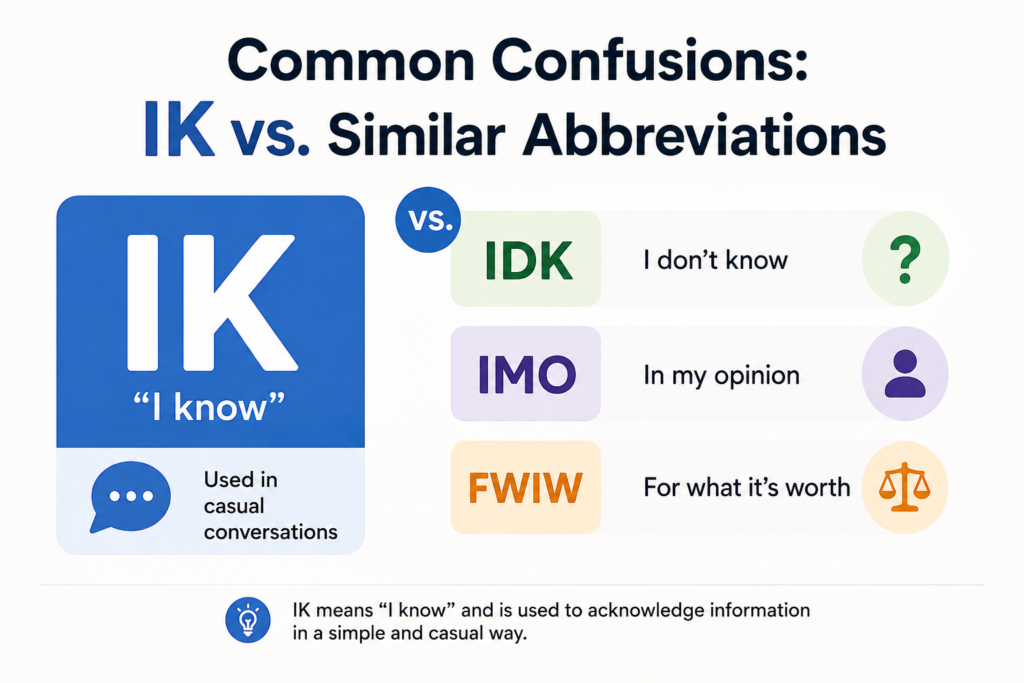
IK vs. IDK
This is the most important distinction. These two are complete opposites.
- IK = I know (certainty)
- IDK = I don’t know (uncertainty)
Getting these mixed up can completely reverse the meaning of a message. If someone asks, “Do you know how to get there?” responding with “IK” means yes, you know. Responding with “IDK” means you have no idea. The D makes all the difference.
IK vs. OK
- OK = acceptance or agreement without necessarily claiming prior knowledge
- IK = specifically affirming that you already knew something
“The meeting is at 3pm.” “OK” → I acknowledge this information. “IK” → I already knew this.
The subtle difference is about awareness versus acknowledgment.
IK vs. Got It
- Got it → implies you just received or understood new information
- IK → implies the information wasn’t new to you
Using “IK” when someone corrects you could sound dismissive. “Got it” is the more gracious option in those situations.
IK vs. Yeah / True / Exactly
These all express agreement, but differ in nuance:
- Yeah → casual, slightly more affirming
- True → validates the statement more explicitly
- Exactly → shows strong, precise agreement
- IK → agreement + claiming prior knowledge
How to Respond When Someone Says “IK”
IK Mean, How you respond to “IK” depends on what emotional signal the person is sending:
If it’s enthusiastic: Mirror the energy. “IK RIGHT?? 😂” calls for a continued excited conversation.
Response: “Exactly! That’s what I’m saying!”
If it’s a casual acknowledgment: Just continue the conversation naturally. No need to address the “IK” itself.
Response: (Continue with what you were discussing)
If it sounds dismissive or impatient: Don’t push back aggressively. Either clarify why you were saying it, or gently ask if everything’s okay.
Response: “Just wanted to make sure — didn’t mean to repeat myself!”
If it seems sarcastic: Match with humor or ask for clarification to avoid misreading the room.
Response: “Ha — fair enough 😅”
If it feels like a conversation-ender: Respect the signal. One-word responses often mean the person isn’t in the mood for extended chat.
Response: Keep it brief and wrap up naturally.
When NOT to Use “IK”
Knowing when to avoid “IK” is just as important as knowing how to use it.
Professional Communication
In emails, work reports, formal Slack messages to management, or any client-facing communication, “IK” should be replaced with full phrases:
- Instead of “IK” → Use “I understand,” “I’m aware,” “Noted,” or “Understood.”
Even in workplaces with casual cultures, using “IK” with someone you don’t know well can come across as flippant or dismissive.
Emotional Conversations
If someone shares something vulnerable — grief, anxiety, personal struggle — responding with just “IK” is likely to feel cold and insufficient, even if you do genuinely relate.
- Instead of “IK” → Use “I understand how that feels” or “IK, and that’s really hard — I’m here.”
When You Actually DON’T Know
This sounds obvious, but using “IK” to seem knowledgeable when you’re not is a habit that can lead to real miscommunication. If you’re unsure, use IDK — honesty is always more valuable than appearing informed.
The Psychology Behind Why “IK” Is So Popular
Linguists and communication researchers have noted that the appeal of abbreviations like “IK” goes beyond just convenience. There are psychological reasons why people prefer them in digital spaces:
1. Speed = Power in Digital Conversations Responding quickly in text conversations signals engagement. “IK” lets you respond instantly without sacrificing acknowledgment.
2. Emotional Distance Control Shorter responses give people more control over emotional investment. “IK” can communicate agreement while deliberately keeping the emotional temperature of a conversation low.
3. In-Group Signaling Using casual slang fluently signals belonging — you’re part of the digital culture, you know the language, you’re “in the group.” For teenagers especially, this linguistic fluency is socially important.
4. Tone Without Voice In text communication, we lose the vocal cues that naturally convey meaning. Punctuation, capitalization, and abbreviated words like “IK” have become our substitute for vocal tone — compressed emotional signals in a voiceless medium.
“IK” in Technical and Professional Fields
Outside of texting, “IK” has entirely separate meanings in specialized fields:
Robotics and Computer Graphics — Inverse Kinematics
In the world of animation, game development, and robotics, IK stands for Inverse Kinematics. This is a mathematical technique used to calculate how the parts of a jointed structure (like a robot arm or an animated character’s limb) need to move in order to position an endpoint — like a hand or foot — in a desired location.
For example, when a video game character reaches out to grab an object on a shelf, inverse kinematics calculates the angles of each joint in the arm so the hand lands exactly where it should. It’s a fundamental concept in 3D animation and robotics engineering.
Medical and Immunology — Interleukin (IK)
In medical and biological contexts, IK can refer to interleukins — a group of cytokine proteins that play critical roles in the immune system. Interleukins help regulate the growth, activity, and differentiation of immune cells. They are studied extensively in research related to autoimmune diseases, cancer, and inflammatory conditions.
Aviation and Engineering Codes
In aviation documentation, technical manuals, and military engineering, “IK” may appear as a specific code or abbreviation defined within that system’s nomenclature. The meaning is entirely context-dependent and should always be interpreted within the relevant documentation.
“IK” Across Generations: Who Uses It and How
One of the interesting dimensions of “IK” is that different generations relate to it differently:
Gen Z (born 1997–2012): The most fluent users. For Gen Z, “IK,” “ik,” and “IKKKK” are second nature, with full command of the emotional range. They’re most likely to use elaborate variations with emojis and intentional capitalization shifts.
Millennials (born 1981–1996): Grew up with the early internet and are equally comfortable with “IK,” though they may use it slightly more sparingly. They were there for its origin in the SMS and AIM era.
Gen X (born 1965–1980): May use “IK” in casual texts but are less likely to employ the nuanced emotional variations. More likely to write “I know” in full in many contexts.
Baby Boomers (born 1946–1964): Least likely to use or recognize “IK” without explanation. May interpret a blunt “ik” as a typo or rude non-answer.
Understanding this generational gap matters — especially in cross-generational communication. What feels like normal casual speech to a 20-year-old can feel dismissive or incomprehensible to a 60-year-old.
Cultural and Regional Differences
While “IK” is predominantly used in English-speaking digital spaces, its reach is genuinely global. However, usage patterns vary:
- U.S., UK, Canada, Australia: Heavy usage across all age groups under 40; widely understood
- South Asia and Southeast Asia: Common among English-speaking youth, especially on platforms like WhatsApp and Instagram
- Non-English-speaking countries: Less common, though English internet slang increasingly bleeds across linguistic borders through platforms like TikTok and YouTube
- Interestingly: In Dutch, “ik” literally means “I” (first-person pronoun). Dutch speakers occasionally experience humorous confusion when encountering “IK” in English digital contexts.
Quick Reference: Everything You Need to Know at a Glance
| Category | Detail |
|---|---|
| Full meaning | I know |
| Type | Informal abbreviation / internet slang |
| Origin | Late 1990s SMS and instant messaging era |
| Platforms | WhatsApp, Instagram, TikTok, Snapchat, Discord, iMessage, dating apps |
| Tone range | Agreement → sarcasm → impatience → flirtation → empathy |
| Common variations | IK, ik, IKR, IKKK, IK IK, IKWYM |
| Easily confused with | IDK (I don’t know) — the opposite meaning |
| Professional use | Avoid in formal/client-facing communication |
| Technical meanings | Inverse Kinematics (robotics), Interleukins (medicine) |
| Best used with | Friends, peers, casual social media interaction |
Conclusion: Two Letters, Infinite Nuance
IK Mean, “IK” is a perfect window into how modern digital communication works. On the surface, it’s just a two-letter shortcut for “I know.” But look closer, and you’ll find a word that can express joy, sarcasm, exhaustion, dismissal, empathy, confidence, or playfulness — all depending on where you put a period, whether you capitalize it, which emoji you attach, and what conversation it’s living inside.
Understanding “IK” isn’t just about decoding a text abbreviation. It’s about understanding that digital communication has its own grammar, its own emotional vocabulary, and its own evolving culture. The more fluent you become in reading these signals, the richer and clearer your digital conversations will be.
So the next time you see “ik” at the end of a message, don’t just read it as “I know.” Ask yourself: what kind of “I know” is this? Because that’s where the real meaning lives.
Have questions about other texting abbreviations? This guide is part of our ongoing series on internet slang and digital communication. Check out our coverage of IDK, IKR, IKWYM, and more.

