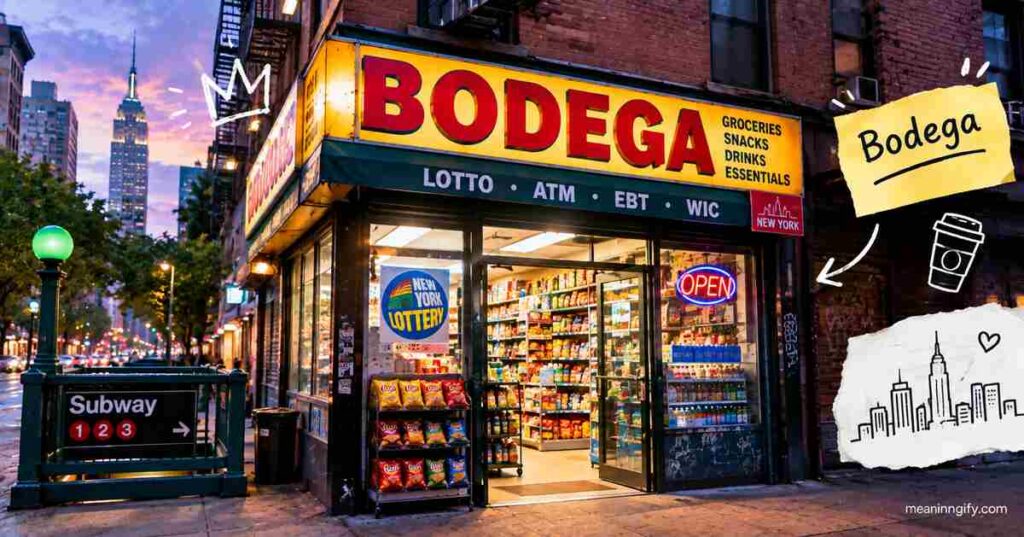

Ask a New Yorker where to grab a coffee, a lottery ticket, or a 2 a.m. snack, and they’ll point you to the nearest bodega. This guide covers what bodega actually means, where the word came from, and how it grew from a Spanish term for a wine cellar into one of New York City’s most recognizable cultural symbols.
Table of Contents
- Quick Answer
- Bodega Meaning Overview
- What Does Bodega Mean?
- Bodega Meaning in Slang
- Bodega Meaning in New York Culture
- What Is a Bodega Cat?
- Bodega Meaning on Social Media
- Bodega vs Convenience Store
- Bodega vs Grocery Store
- Why Are Bodegas Important?
- Bodega Meaning in Fashion and Culture
- Is Bodega Still Popular in 2026?
- Related Slang Words
- FAQs
- Final Thoughts
Quick Answer
A bodega is a small, independently owned corner store, most associated with New York City, that sells groceries, snacks, drinks, and everyday essentials. The word comes from the Spanish term for “wine cellar” or “storeroom.”
Examples
- “I’m just running to the bodega for some eggs.”
- “The bodega on my corner is open 24 hours.”
- “That bodega cat basically runs the place.”
Bodega Meaning Overview
| Aspect | Details |
|---|---|
| Literal meaning (Spanish) | Wine cellar, storeroom, or warehouse |
| American meaning | Small neighborhood grocery or convenience store |
| Most associated with | New York City |
| Typical stock | Snacks, drinks, deli sandwiches, household basics, lottery tickets |
| Cultural symbol | The bodega cat |
What Does Bodega Mean?
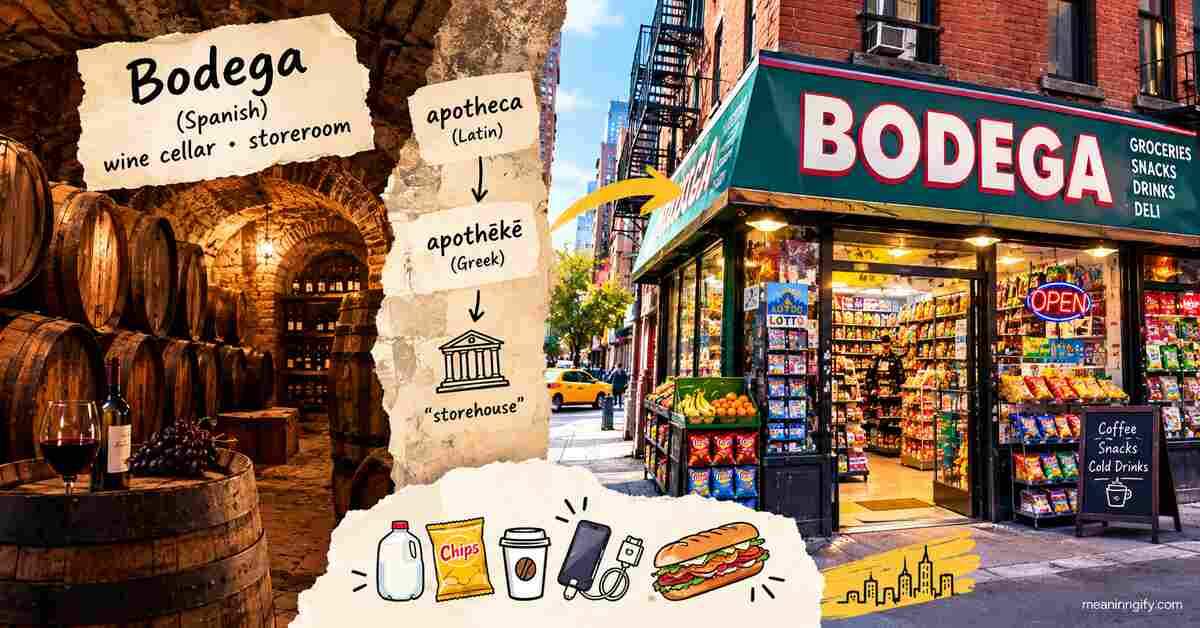
In Spanish, bodega traditionally means a wine cellar, storeroom, or warehouse. The word traces back through Latin apotheca to the Ancient Greek apothēkē, meaning “storehouse” ; the same root that gave English the word “apothecary.”
In the United States, and especially in New York City, “bodega” means something more specific: a small, independently run corner store that sells a little bit of everything. Think milk, chips, phone chargers, coffee, and a deli counter, often packed into a tiny storefront that’s open around the clock.
Read More : What Does TTYL Mean? History, Origins and Examples (2026)
Where the Word Changed Meaning
The shift from “wine cellar” to “corner store” happened as Spanish-speaking immigrant communities, particularly from Puerto Rico and Cuba, settled in New York in the mid-20th century. They used “bodega” for the small grocery stores they opened, and the word stuck, eventually spreading far beyond Hispanic neighborhoods to describe this kind of store citywide.
Bodega Meaning in Slang
Outside of its literal definition, “bodega” carries a cultural shorthand. Saying “the bodega” doesn’t just mean any store, it implies a specific vibe:
- Hyper-local. Your bodega is the one on your corner, not a chain.
- Familiar. Regulars often know the owner, and the owner knows them.
- Always open. Many bodegas run 24/7, making them a go-to for odd-hour errands.
- A little chaotic, in a good way. Tight aisles, deli counter in the back, random inventory stacked to the ceiling.
In casual conversation, “bodega” can also describe an aesthetic, cluttered shelves, hand-written signs, a cat curled up by the register, even when people are talking about a store that isn’t technically in New York.
Bodega Meaning in New York Culture
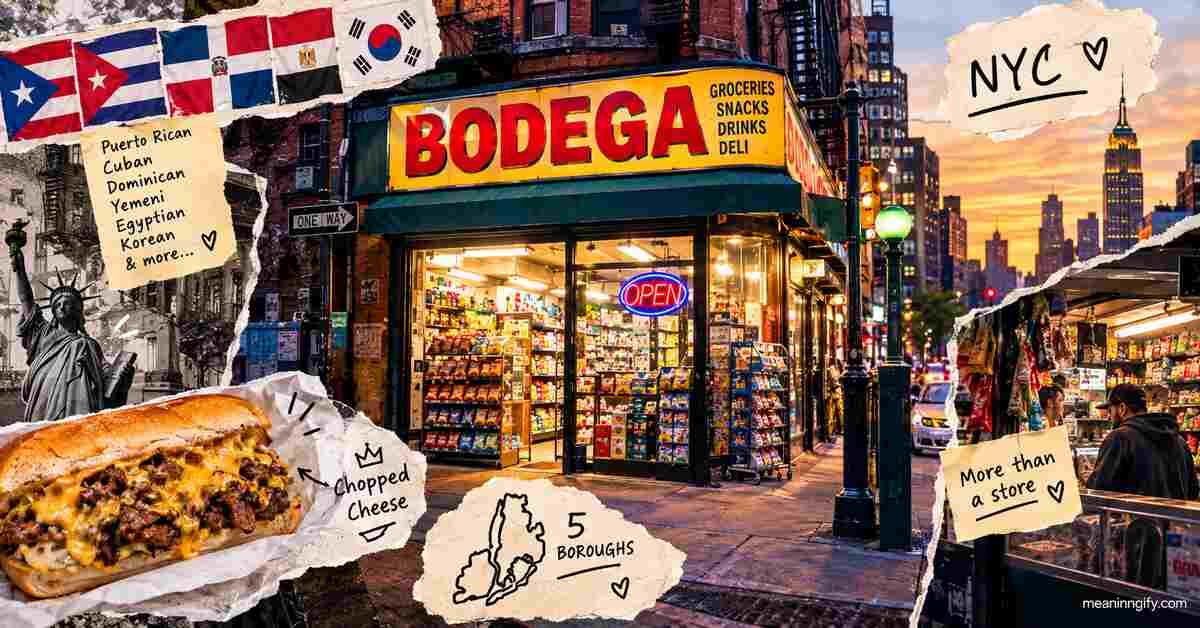
Bodegas aren’t just stores in New York, they’re part of the city’s identity. By 2020, there were an estimated 13,000 bodegas across New York City, making them one of the most common small businesses in the five boroughs.
Their roots trace to a mix of immigrant communities. Puerto Rican and Cuban immigrants popularized the term in the mid-20th century, and over the decades, Dominican, Yemeni, Egyptian, Korean, and other immigrant groups have carried the bodega tradition forward, each adding their own touch to the shops.
Bodegas are often described as an extension of the home, places where customers are regulars, not just shoppers. They’re also behind some of the city’s most iconic food, including the chopped cheese sandwich, a beef-and-cheese griddle sandwich that started as a bodega specialty.
What Is a Bodega Cat?
A bodega cat is a cat that lives and works inside a bodega, usually kept to control mice and insects drawn in by food storage. Bodega cats have been part of New York stores for over a century and have become minor celebrities in their own right.
A few reasons they’ve become icons: cramped storerooms naturally attract pests, so cats are a practical, chemical-free fix; regulars often know the cat’s name before they know the owner’s; entire social accounts are dedicated to photographing bodega cats around the city; and when health codes threaten to remove a bodega cat (pets technically aren’t allowed in food-selling stores), New Yorkers tend to push back loudly in the cat’s defense.
A bodega without a cat can feel like it’s missing something, even to customers who’ve never personally met the one in question.
Bodega Meaning on Social Media
Bodega culture translates easily to short-form video and photo platforms. On TikTok and Instagram, it usually shows up as bodega cat spotlights, “what’s in my bodega” store tours, chopped cheese and bacon-egg-and-cheese reviews, or nostalgia posts about someone’s childhood bodega.
This online attention has introduced bodega culture to audiences far outside New York, turning a hyper-local word into something people recognize nationally, even if they’ve never set foot in one.
Bodega vs Convenience Store
Bodegas and convenience stores overlap, but New Yorkers generally treat them as different things.
| Feature | Bodega | Convenience Store |
|---|---|---|
| Ownership | Usually independently owned | Often part of a chain |
| Atmosphere | Personal, regulars known by name | More standardized, less personal |
| Inventory | Eclectic mix, deli counter common | Standardized product lines |
| Hours | Frequently 24/7 | Varies by chain and location |
| Cultural identity | Closely tied to New York’s immigrant history | Found nationwide, less regionally specific |
| Mascot | Often a bodega cat | Rare |
A 7-Eleven can technically be called a convenience store, but most New Yorkers wouldn’t call it a bodega, the word carries a specific local, independent, and personal feel.
Bodega vs Grocery Store
Grocery stores and bodegas both sell food, but the scale and purpose differ a lot.
| Feature | Bodega | Grocery Store |
|---|---|---|
| Size | Small, often a single aisle or two | Large, multiple aisles |
| Purpose | Quick stops, daily essentials | Full weekly shopping trips |
| Produce selection | Limited | Extensive |
| Prepared food | Common (sandwiches, coffee) | Sometimes, in larger stores |
| Typical visit | A few minutes | 20+ minutes |
If you need a week’s worth of groceries, you go to the supermarket. If you need milk at 11 p.m. or a sandwich on your way to work, you go to the bodega.
Why Are Bodegas Important?
Bodegas do more than sell snacks. They function as informal community hubs, especially in dense urban neighborhoods, offering accessibility for residents without a car, a path to small business ownership for immigrant families, a personal connection between owners and regulars, a reflection of the specific communities that run them (Dominican, Yemeni, Korean, and more), and round-the-clock reliability in a city that never fully sleeps.
Bodega Meaning in Fashion and Culture
Beyond the storefront, “bodega” has become shorthand for a certain kind of gritty, authentic urban aesthetic. Streetwear brands have leaned into this directly, there’s a well-known sneaker and apparel brand literally named Bodega, drawing on the corner store’s low-key, insider appeal.
Designers and brands frequently borrow bodega visual cues, hand-painted signage, cluttered shelving, deli-counter imagery, to signal street-level authenticity. College and streetwear collections have even featured bodega storefronts and bodega cats as central design motifs, a sign of how deeply the aesthetic has embedded itself in broader fashion culture.
Is Bodega Still Popular in 2026?
Yes. Bodegas remain a fixture of New York life, and the word’s cultural reach has only grown. Social media keeps bodega culture visible to people who’ve never lived in a dense city, new immigrant communities keep the tradition active and evolving, streetwear and design culture keep borrowing bodega aesthetics, and no synonym, “corner store,” “convenience store”, carries quite the same warmth or specificity.
Related Slang Words
Bodega belongs to a wider vocabulary of regional words for the same basic idea — a small neighborhood store:
- Deli : short for delicatessen, common in and around New York
- Corner store : a general, informal U.S. term
- Party store : regional term used in parts of the Midwest
- Packie : short for “package store,” used in parts of New England for liquor stores
- Sari-sari store : the Filipino equivalent of a small neighborhood shop
FAQs
What does bodega mean in English?
In English, bodega usually refers to a small, independently owned corner store, especially in New York City, that sells groceries and everyday essentials.
What does bodega mean in Spanish?
In Spanish, bodega traditionally means a wine cellar, storeroom, or warehouse, though the exact meaning varies by country.
Why are bodegas associated with New York?
Spanish-speaking immigrants, especially from Puerto Rico and Cuba, popularized the term in New York in the mid-20th century, and it became part of the city’s identity.
What is a bodega cat?
A bodega cat is a cat that lives in a bodega, usually to control pests, and often becomes a beloved neighborhood fixture.
Is a bodega the same as a convenience store?
They’re similar, but a bodega is typically independently owned with a more personal, neighborhood feel, while convenience stores are often part of a chain.
Is “Bodega” also a brand name?
Yes. Bodega is also the name of a streetwear and sneaker brand that draws on the corner store’s low-key, insider aesthetic.
Final Thoughts
Bodega started as a Spanish word for a wine cellar and became one of New York City’s most recognizable cultural institutions. It’s a store, a community hub, a sandwich shop, and ; more often than not ; home to a cat that runs the place.
Whether you’re grabbing a late-night snack, scrolling past bodega cat videos, or shopping a streetwear drop that borrows the aesthetic, the word carries the same idea: small, local, and unmistakably authentic.