
Seen “LYK” in a text and wondered what your friend was trying to tell you? You’re not alone. This small acronym shows up constantly in casual conversations, but its meaning can shift slightly depending on who’s typing it and where. This guide breaks down exactly what LYK means, where it came from, and how to use it correctly.
Meaning & Definition
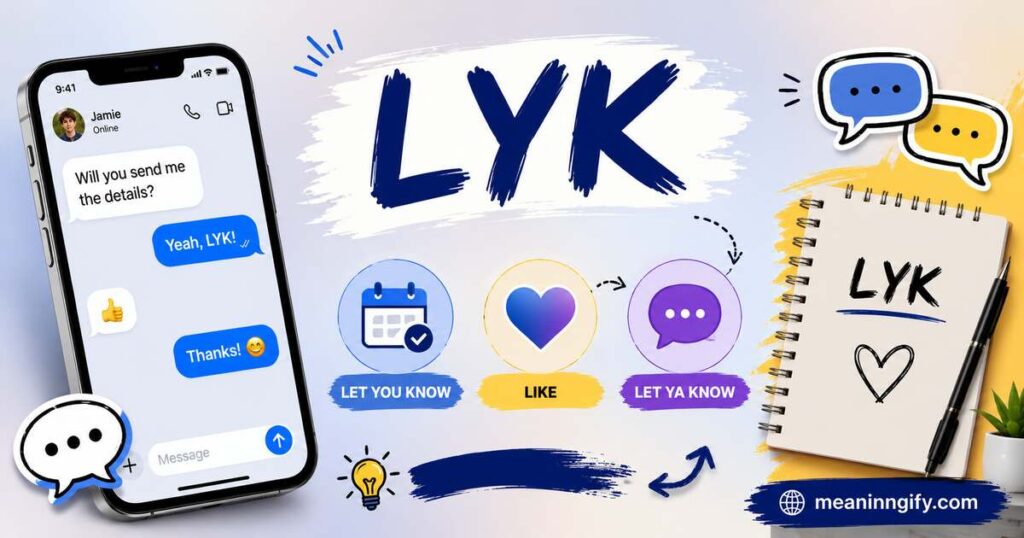
In most texting and social media contexts, LYK stands for “Let You Know,” used when someone plans to share an update later rather than right away. It’s a quick way of saying “I’ll keep you posted” without typing the full phrase.
Depending on context, LYK can also mean:
- Let You Know : the dominant meaning, promising a future update
- Like : a shortened, stylized spelling some texters use instead of the full word
- Let Ya Know : a casual variation with the same meaning as “let you know”
Because the primary meaning is so consistent, LYK is actually one of the easier acronyms to interpret correctly, though it’s still worth checking the sentence structure to rule out the “like” spelling.
Background
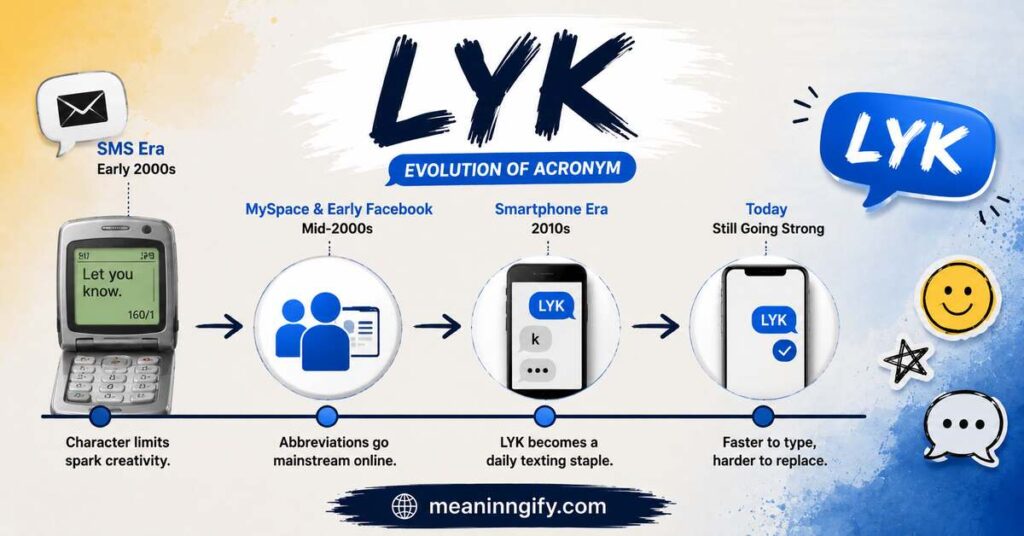
LYK emerged during the early days of SMS texting, when character limits and per-message costs pushed people to shorten common phrases wherever possible. “Let you know” was already a frequently used phrase in everyday conversation, making it a natural candidate for abbreviation.
It spread alongside other early internet staples like LOL and BRB, gaining wider traction in the mid-2000s as platforms like MySpace and early Facebook normalized casual, abbreviation-heavy communication. Smartphone adoption in the 2010s cemented its place in everyday texting, and even though character limits eventually became less of a concern, the habit of using LYK stuck around simply because it’s faster to type.
Usage in Different Contexts (Chat, Social Media, Professional Fields)
| Context | Likely Meaning | Tone |
|---|---|---|
| Texting between friends | Let You Know | Casual, informal |
| Instagram/TikTok comments | Let You Know | Conversational |
| WhatsApp group chats | Let You Know | Informal |
| Slack/Teams messages | Let You Know | Casual-professional |
| Formal emails or reports | Avoided, spelled out fully | Formal |
| Stylized captions | Like (shortened spelling) | Casual, trendy |
Read More : What Does ATP Mean in Text? A Complete Guide to Its Meanings Across Contexts
In professional settings, LYK is generally avoided in formal writing but is often acceptable in casual internal messaging platforms like Slack, where a more relaxed tone is already the norm.
Meaning in Chat, WhatsApp, Instagram, TikTok
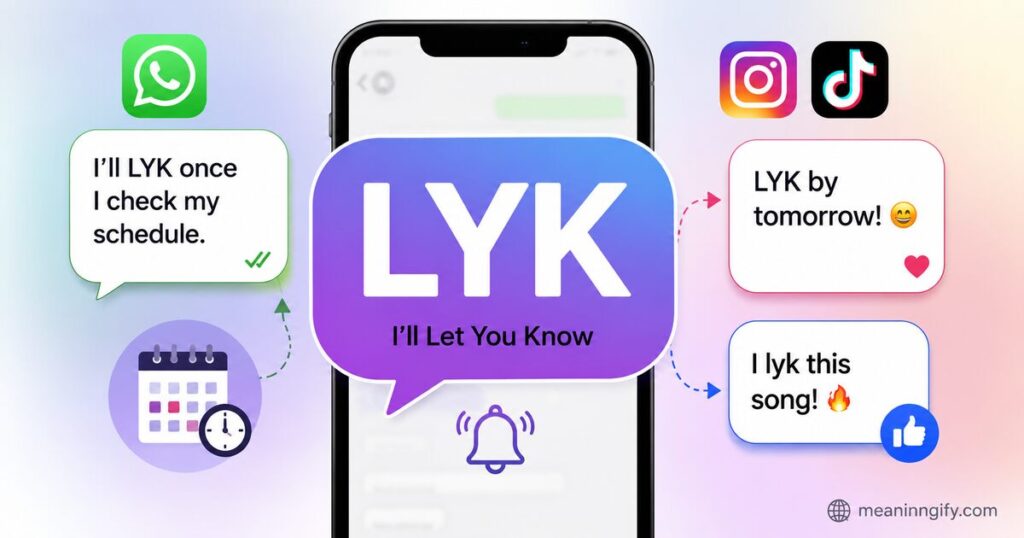
On WhatsApp and regular texting, LYK is almost always used to promise a future update, “I’ll LYK once I check my schedule” is a typical example.
On Instagram and TikTok, it shows up in captions and comments the same way, often paired with a specific timeframe like “LYK by tomorrow” to set expectations for when the update will come.
Occasionally, especially in comments reacting to posts, LYK is used as a stylized spelling of “like” instead, “I lyk this song”, so it’s worth glancing at the sentence to see which meaning fits.
Meaning in Physics, Medical, and Aircraft Terminology
Outside of texting, LYK does not have an established meaning in physics, medicine, or aviation. Unlike acronyms that carry a dual life between slang and technical fields, LYK remains almost entirely confined to casual digital communication, with no recognized formal or scientific definition tied to it.
Common Misconceptions
A few mix-ups come up with this acronym:
- Assuming LYK means an immediate answer. It actually signals a future update, not information being shared right now.
- Confusing it with FYI. FYI shares information immediately, while LYK promises to share information later.
- Missing the “like” spelling variation. In some casual captions, LYK is simply a shortened version of “like,” not the phrase “let you know” at all.
Reading the full sentence, rather than just the acronym, clears up almost every case of confusion.
Similar Terms & Alternatives
A few other acronyms serve a similar or related function:
- LMK : “Let Me Know,” the reverse request, asking someone else to provide an update
- FYI : “For Your Information,” sharing something immediately rather than promising a future update
- TBD : “To Be Determined,” used when a decision hasn’t been made yet
- IDK : “I Don’t Know,” expressing uncertainty rather than a promise to follow up
Compared to these, LYK is unique in specifically promising future communication rather than expressing current uncertainty or sharing information right away.
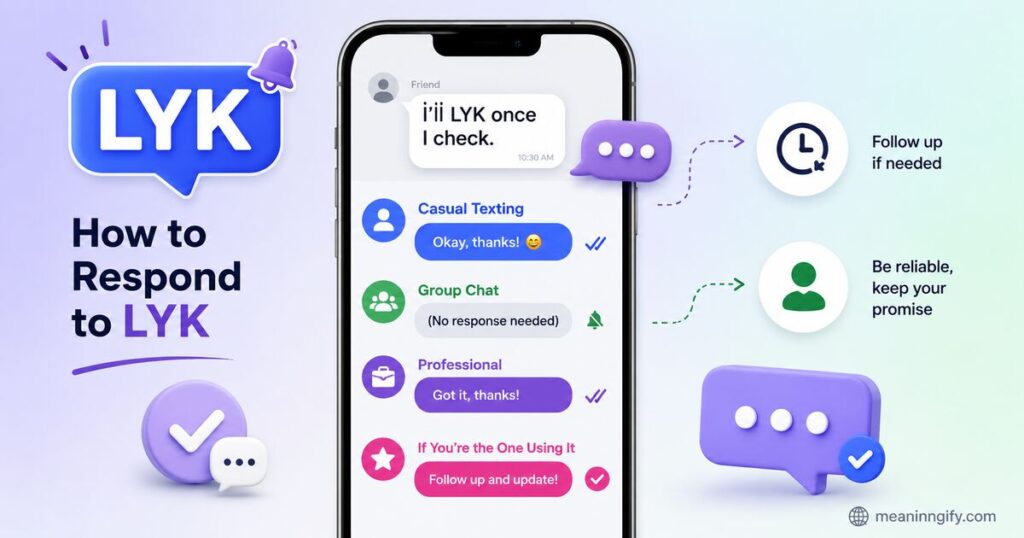
How to Respond to It
How you respond depends on what’s being discussed:
- In casual texting: A simple “okay, thanks!” or “sounds good” works fine while you wait for the update.
- In group chats: No response is usually necessary; LYK signals the sender will follow up when they have news.
- In professional messaging apps: Treat it the same as a promised follow-up, and check back if you haven’t heard anything within a reasonable time.
- If you’re the one using it: Try to actually follow through and update the person, since LYK sets a small expectation.
Differences from Similar Words
| Term | Typical Meaning | Formality |
|---|---|---|
| LYK | Let You Know | Informal |
| LMK | Let Me Know | Informal |
| FYI | For Your Information | Informal to semi-formal |
| TBD | To Be Determined | Informal to formal |
The key difference between LYK and LMK is direction, LYK means you’ll update someone else, while LMK means you’re asking someone else to update you.
Relevance in Online Conversations & Dating Apps
In dating app conversations, LYK often shows up when someone is deciding on plans, like “Not sure if I’m free Friday, I’ll LYK by tomorrow.” It’s a low-pressure way to keep a conversation open without committing immediately, which makes it common in early-stage texting where schedules and interest levels are still being figured out. Used naturally, it signals that a person is engaged and planning to follow up, rather than leaving the conversation hanging without explanation.
Conclusion
LYK is a simple, widely understood acronym that mostly means “let you know,” used whenever someone plans to follow up with information later rather than immediately. Because it has one dominant meaning across most platforms, it’s one of the easier texting abbreviations to use with confidence, just remember to actually follow through when you say it.