
ARD Mean, You’re scrolling through your messages and someone replies with just “ard.” No explanation, no punctuation, no emoji. Simple as it looks, that three-letter word carries more meaning than most people realize, and it can mean different things depending on who sent it, where you’re talking, and what the conversation is about.
This guide breaks down everything you need to know about ARD: its core meaning, where it came from, how it’s used across platforms, and when it’s appropriate to use it yourself. Whether you’ve seen it on TikTok, received it on WhatsApp, or spotted it in a dating app conversation, you’ll walk away knowing exactly what it means.
Meaning & Definition
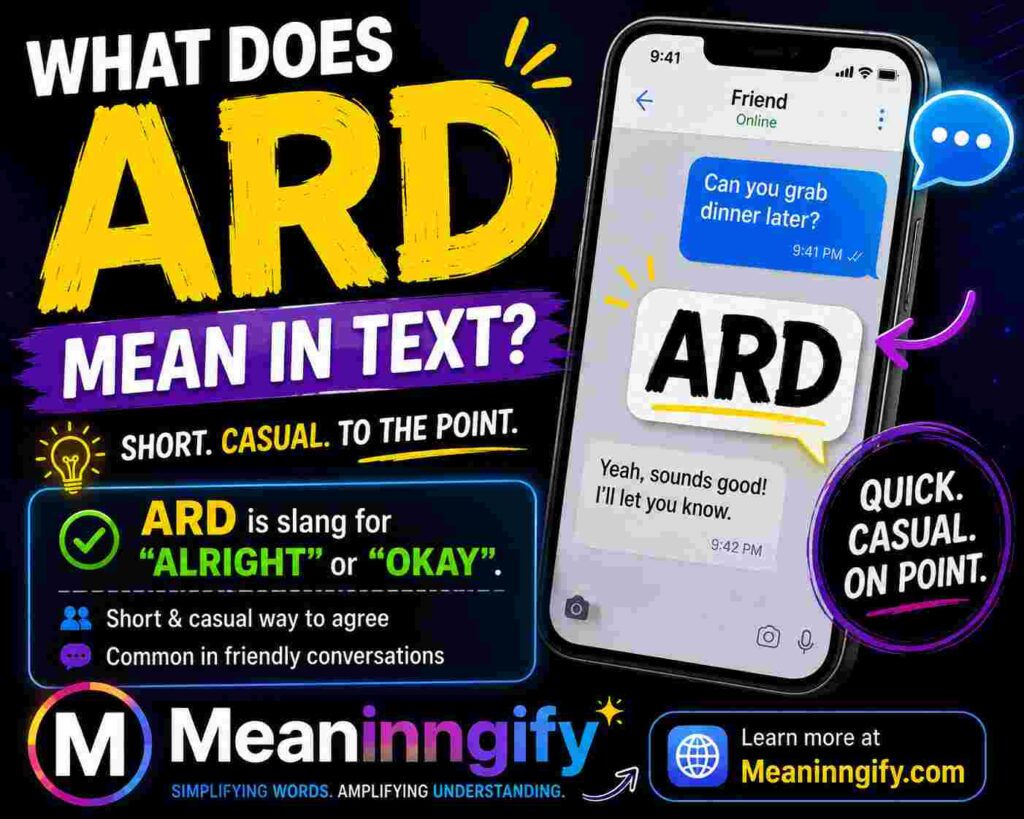
At its most basic, ARD is an informal slang abbreviation that primarily means “alright.” It’s used to signal agreement, acknowledgment, or acceptance, the textual equivalent of nodding and saying “okay, cool.”
Here’s a quick reference for all common meanings:
| Meaning | Full Form | Context |
| ARD | Alright | Casual texting, social media, everyday chats |
| ARD | Already | Sentence structure suggests completion |
| ARD | Are You Down | Invitations, social or dating contexts |
| ARD | Acute Respiratory Disease | Medical/clinical documentation |
| ARD | Aircraft Readiness Date | Aviation, maintenance scheduling |
| ARD | Absolute Risk Difference | Statistics and public health |
| ARD | Apple Remote Desktop | Technology, IT support |
| ARD | Automatic Route Discovery | Engineering, networking |
In everyday digital communication, “alright” is the meaning you’ll encounter roughly 90% of the time. The others appear only in specialized, professional settings, and they’re never used casually.
Background
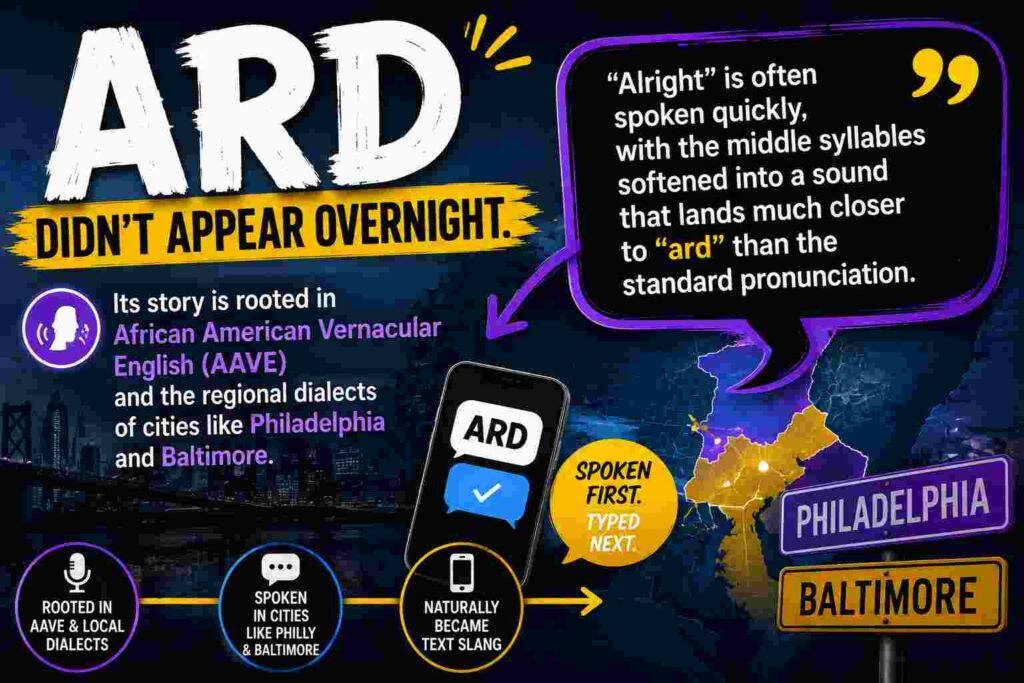
ARD didn’t appear overnight. Its story is rooted in African American Vernacular English (AAVE) and the regional dialects of cities like Philadelphia and Baltimore, where “alright” is often spoken quickly, with the middle syllables softened into a sound that lands much closer to “ard” than the standard pronunciation.
Philadelphia speakers were using “ard” in everyday face-to-face conversation long before smartphones existed. When SMS texting went mainstream in the early 2000s, people naturally started writing the way they talked, and “ard” made the jump from spoken slang to typed shorthand with zero friction.
The earliest recorded use of “ard” as written slang traces back to around 2008, when it began appearing in online communities associated with Philadelphia youth culture. By 2010, social media started carrying it beyond the Northeast. By the mid-2010s, it had gone fully national, spread further by hip-hop music, memes, and the rise of platforms like Twitter, Instagram, and eventually TikTok.
Today, ARD is recognized across age groups and regions as a quick, no-fuss way to say “I’m good with that.”
Usage in Different Contexts (Chat, Social Media, Professional Fields)
Chat & Messaging
In private texting conversations, ARD functions almost identically to “okay,” “cool,” or “sounds good.” It confirms a plan, acknowledges a message, or shows you’ve heard what someone said without necessarily adding anything new to the conversation.
- “I’ll be there at 8.” → “Ard.” (Plan confirmed)
- “I ARD told you about this.” → “I already told you about this.” (Completion, past action)
- “You good with pizza tonight?” → “ARD.” (Casual agreement)
Context within the sentence usually makes the “alright” vs. “already” distinction obvious. If it appears mid-sentence in a way that refers to something that happened before, it likely means “already.”
Read More : What Does SMD Mean in Text? A Complete Guide to Its Meanings, Uses, and Contexts
Social Media
On social platforms, ARD shows up primarily in comments and replies. It’s a fast, efficient way to react to content without typing out a full response.
- On Instagram, you might see it in comments agreeing with a caption or confirming plans made in DMs.
- On TikTok, creators and commenters use it to express low-key agreement or approval of content.
- On Twitter/X, it appears in reply threads as a casual acknowledgment.
In the social media world, ARD fits the general preference for short, snappy language. It doesn’t stand out, it blends naturally into fast-moving conversations.
Professional Fields
This is where the tone shifts completely. In workplace settings, ARD either means something highly specific (see the technical meanings in the table above) or it simply doesn’t belong. Using “ard” in a professional email, Slack channel, or business report would come across as unprofessional or unclear to many colleagues, especially those outside Gen Z or unfamiliar with AAVE-derived slang.
The professional contexts where ARD does appear carry precise definitions, Aircraft Readiness Date in aviation, Absolute Risk Difference in public health research, Apple Remote Desktop in IT support, and these have nothing to do with texting culture.
Meaning in Chat, WhatsApp, Instagram, TikTok
Different platforms shape how ARD is read, even when the core meaning stays the same.
WhatsApp: ARD is common in one-on-one chats and group conversations between friends. It’s a low-effort reply that keeps a conversation moving. On its own, it can feel neutral or slightly short, adding an emoji softens the tone if needed.
Instagram: In DMs or comments, ARD usually signals casual agreement or confirmation. Someone might reply “ard” to a post featuring plans, meetups, or suggestions.
TikTok: ARD appears heavily in comment sections, often as a reaction to a creator’s point essentially a written shrug of agreement. The fast, scroll-heavy culture of TikTok makes short responses like ARD feel natural.
Snapchat: On Snapchat, ARD commonly means “alright” or “okay” as a quick snap reply, signaling that the sender has read the snap and is good with whatever was shared.
Gaming Platforms (Discord, in-game chat): Gamers use ARD constantly to confirm readiness or agree to a plan mid-session. “ARD, let’s start the raid” or “ARD, switching lanes” are typical examples.
Meaning in Physics, Medical, and Aircraft Terminology
Outside of casual texting, ARD takes on very different and very specific meanings depending on the field:
Medical Field:
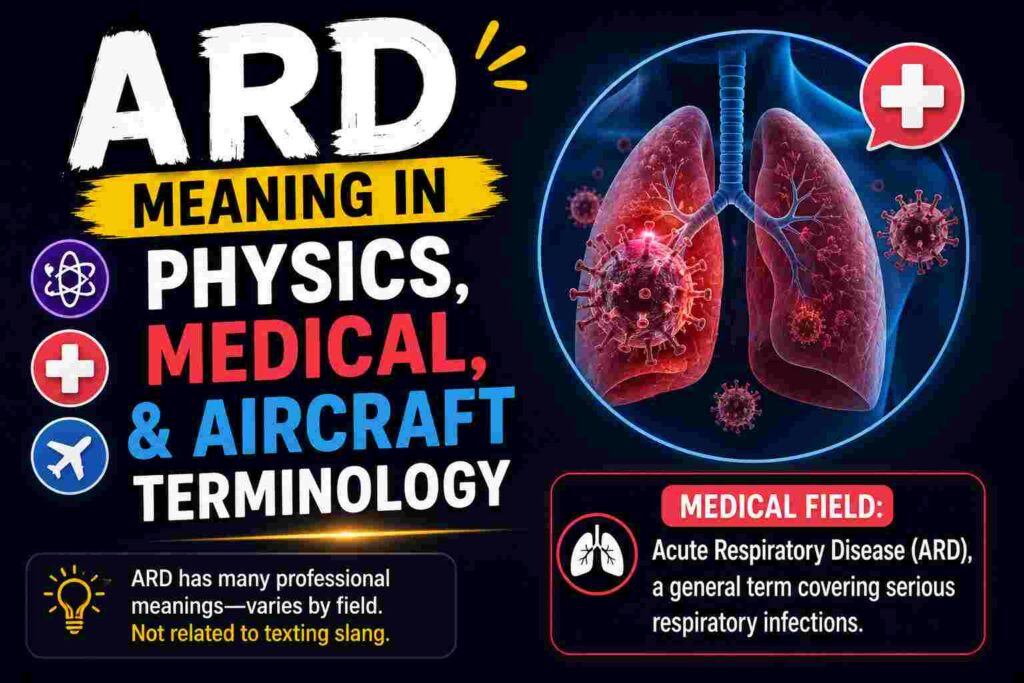
- Acute Respiratory Disease (ARD), a general term covering serious respiratory infections, distinct from the more specific ARDS (Acute Respiratory Distress Syndrome)
- Androgen Receptor Domain, appears in research related to hormonal biology and oncology
- Annual Review Document, used in some clinical and educational evaluation frameworks
Aviation & Engineering:
- Aircraft Readiness Date (ARD), a scheduling term indicating when an aircraft is expected to be operationally ready after maintenance
- Aircraft Reference Data, used in technical documentation for aviation systems
Statistics & Public Health:
- Absolute Risk Difference (ARD), a key epidemiological measure comparing the risk of an outcome between two groups; widely used in clinical trial reporting
Technology:
- Apple Remote Desktop (ARD), Apple’s tool for remotely managing Mac computers on a network
- Automatic Route Discovery, a networking protocol concept in engineering contexts
These meanings are entirely separate from texting slang and are only encountered in their respective professional domains.
Common Misconceptions
A few misunderstandings circulate regularly around ARD:
- “ARD must be a typo for ‘hard’ “, It’s not. ARD is intentional and has a clear meaning. The phonetic similarity to “hard” is coincidental.
- “ARD always sounds rude or dismissive” , Not necessarily. A short reply can feel cold in an emotional conversation, but in most casual exchanges, ARD is completely neutral or even friendly. Tone depends on everything surrounding it, not the word itself.
- “ARD is only used by young people” , While it originated in youth culture and is most common among Gen Z and Millennials, it has spread broadly through social media and music. Age is no longer a reliable predictor of whether someone uses it.
- “ARD has only one meaning” , As the table above shows, it has at least eight documented meanings across different contexts. Always check the context before assuming.
- “ARD is a new internet invention” , Its roots in AAVE and Philadelphia/Baltimore dialect predate social media by decades. The written form is what’s relatively new, not the word itself.
Similar Terms & Alternatives
ARD exists in a family of related slang and formal alternatives. Here’s how they compare:
| Term | Meaning | Tone |
| ARD | Alright | Casual, neutral, regional flavor |
| AIGHT | Alright | Casual, widely recognized, pop culture |
| IGHT | Alright | Very casual, stripped-down |
| BET | Agreed / understood | Enthusiastic, confident |
| OK / K | Okay | Neutral; “K” can feel cold |
| SURE | Sure | Slightly warmer than ARD |
| FR | For real | Agreement with emphasis |
| COOL | Cool | Friendly, laid-back |
| GOT IT | Understood | Slightly more formal |
ARD sits between “K” (which can read as dismissive) and “bet” (which carries more enthusiasm). It’s the middle-ground acknowledgment , agreeable but unhurried.
How to Respond to It
When someone sends you “ARD,” your response depends entirely on the context:
- If it confirms a plan: Just continue normally. No clarification needed. Example: “Ard, see you at 7” ,reply with something like “Perfect, see you then!”
- If it feels too short for the situation: Add warmth in your reply , “Ard sounds good, can’t wait!” shows you’re engaged.
- If it seems to mean “already”: Read the surrounding sentence. If it’s mid-statement about something done in the past, acknowledge accordingly.
- If you genuinely aren’t sure which meaning applies: Ask. A simple “Wait, you mean you’re in or you already did it?” clears things up without making it awkward.
One thing to keep in mind: ARD is not rude by default. If it feels dismissive in a specific conversation, that’s about the context or the relationship, not the word itself.
Differences from Similar Words
ARD is easy to confuse with close cousins, but small differences matter:
- ARD vs. AIGHT: Both mean “alright,” but AIGHT has been in mainstream culture longer and feels slightly more universal. ARD carries a stronger connection to Philadelphia/East Coast origins.
- ARD vs. BET: Both signal agreement, but “bet” is more enthusiastic and confident. ARD is more neutral.
- ARD vs. K: Both are short, but “K” is widely seen as passive-aggressive or cold. ARD reads as casual but not necessarily negative.
- ARD vs. IGHT: These are close siblings , IGHT just drops the “ar” entirely. Both are acceptable in the same settings, but IGHT is slightly more stripped-down.
- ARD vs. Already: When ARD means “already,” it’s abbreviated for speed. Unlike writing “already,” the abbreviation signals informality and fits only casual digital conversation.
Relevance in Online Conversations & Dating Apps
ARD has found consistent use in dating apps and romantic messaging for a few reasons. It’s low-pressure, chill, and doesn’t over-commit emotionally. Replying “ard” to a date suggestion signals interest without seeming too eager , which fits the casual, cool tone many people aim for early in a conversation.
On apps like Tinder, Bumble, or Hinge, you might see it in two ways:
- As a response confirming plans: “ARD, coffee works for me.”
- As “Are You Down?” in an invitation: “ARD to meet up this weekend?”
In group chats and online friend circles, ARD works well as a no-fuss way to keep things moving. It doesn’t demand a long reply and doesn’t stall the conversation.
However, overusing ARD in a dating context can come across as uninterested or emotionally flat. It works best as an occasional, natural response , not as your default reply to everything.
Conclusion
ARD is one of those small words that quietly does a lot of work in digital communication. At its core, it means “alright” , a simple, fast signal of agreement or acknowledgment that grew out of Philadelphia dialect and AAVE long before social media existed. Today it lives comfortably on every major platform, from WhatsApp and TikTok to Discord and dating apps.
The key to using ARD well is knowing your context. In casual chats, it’s perfect. In professional emails, it doesn’t belong. In technical fields , medicine, aviation, statistics , it carries completely unrelated meanings that demand domain-specific knowledge. Once you understand those distinctions, ARD is easy to use confidently and correctly.
Frequently Asked Questions (FAQs)
What does ARD mean in a text message?
ARD most commonly means “alright” , a casual way to agree, confirm, or acknowledge something in informal digital conversation.
What does ARD mean when a girl sends it?
It almost always means “alright” or “okay” , a relaxed, neutral confirmation that she’s heard you or is good with the plan.
What does ARD mean in Snapchat?
On Snapchat, ARD typically means “alright” or “okay,” used as a quick, low-effort reply to a snap or message.
Can ARD mean “already”?
Yes. When used mid-sentence in a way that references a completed action , like “I ARD told you” , it means “already.” Context makes this distinction clear.
Is ARD rude or offensive?
No. ARD is a neutral term. However, a very short reply in an emotional conversation can feel cold regardless of the word used, so tone and setting matter.
Where did ARD slang come from?
ARD originated in African American Vernacular English (AAVE) and is especially tied to Philadelphia and Baltimore dialect, where “alright” is naturally spoken in a way that sounds like “ard.”
Should I use ARD in professional settings?
No. ARD is too informal for work emails, formal documents, or professional chats. Stick to “okay,” “understood,” or “confirmed” in those contexts.
What’s the difference between ARD and AIGHT?
Both mean “alright,” but AIGHT is more widely recognized across the U.S., while ARD is more closely tied to Philadelphia/East Coast origins. Either works in casual texting.
Leave a Comment Cancel Reply
Have a story about encountering ARD in an unexpected place? Know a regional variation we didn’t mention? Drop it in the comments , we’d love to hear it.