

Hook: You Just Got Confused By A Two-Letter Text
YW Mean, You send “thanks so much!” to a friend. Back comes a tiny reply: “yw.”
Two letters. No explanation. If you stopped for a second to decode it, you are not alone.
The quick answer: YW stands for “you’re welcome.” This guide covers where people use it, why it is so common, how it compares with similar replies and when to type the full phrase instead.
I compared a number of explainers on this term. They agree on the core meaning. A few add odd alternate meanings with no real support, so I left those out.
What Does YW Mean? (Simple Definition)
YW = “you’re welcome.” It is a short, casual reply to someone who has just said thank you.
Example:
- “Thanks for the ride!”
- “yw!”
Guides on texting slang describe it as a polite acknowledgment that saves typing, and they say it works the same way across platforms.
Simple Meaning In Easy Words
In easy words: YW = “No problem. Happy to help.”
It tells the other person two things:
- You saw their thanks.
- You were glad to help.
It is friendly and low-effort, like a quick nod.
Where Is YW Used?
Texting (SMS)
This is where YW is most common. It keeps replies short and quick.
Social Media
On Instagram DMs, TikTok comments and Snapchat chats, it answers a thank-you in seconds.
Gaming Chats
Players use it after a teammate thanks them for a revive, a carry or a tip.
Discord & Group Chats
In busy servers, short replies like “yw” keep conversations moving.
Casual Emails (Rarely)
Some people use it in quick, friendly emails to coworkers they know well. Most people still write the full phrase.

Why Do People Use YW Instead Of “You’re Welcome”?
There are a few clear reasons:
- Speed. Two letters take less time than twelve.
- Casual tone. It sounds relaxed, not stiff.
- Chat rhythm. In fast conversations, short replies feel natural.
- Habit. Keyboards often learn shortcuts, which makes them quick to type.
- Warmth without effort. It acknowledges thanks without making a big moment.
One caution: when overused or sent flat, it can feel a little abrupt. Adding an emoji or extra word helps.
Read More : ALR Meaning: What It Really Means in Text and Social Media 2026
Real-Life Examples Of YW In Conversations
| Situation | Message | Reply |
|---|---|---|
| Favor | “Thanks for helping me move!” | “yw!” |
| Gift | “Love the present, thank you!” | “yw 😊” |
| Homework | “Thanks for the notes!” | “yw, good luck!” |
| Gaming | “Thanks for the revive!” | “yw, anytime” |
| Work chat | “Thanks for sending that file.” | “yw!” |
| Compliment | “Thanks, that means a lot.” | “yw, you deserve it” |
A few more:
- “Thanks for waiting.” “yw.”
- “Thank you so much!!” “yw!! happy to help”
- “ty!” “yw”
Notice how TY and YW often appear together as a pair.
YW vs Similar Terms (Comparison Table)
| Term | Meaning | Tone | Example |
|---|---|---|---|
| YW | You’re welcome | Casual, polite | “yw!” |
| TY | Thank you | Casual thanks | “ty so much” |
| NP | No problem | Relaxed | “np, anytime” |
| NW | No worries | Calm, reassuring | “nw, glad to help” |
| YWW | A less common variant | Rare | rarely seen |
| Anytime | Happy to help again | Warm | “anytime!” |
| My pleasure | You’re welcome (formal) | Polished | “my pleasure” |
The main difference: YW directly answers a thank-you. NP and NW say “it was nothing.” TY goes the other way and thanks someone.
When Should You Use YW?
Good Times To Use YW:
- Texting friends, family or classmates
- Replying to a quick thank-you in a casual chat
- Gaming or Discord conversations
- Informal work chats with people you know well
Times To Avoid YW:
- Formal emails to clients, managers or professors
- Job applications and professional messages
- Customer service replies, where full phrases sound more polite
- Conversations with people who may not know slang
In those cases, write “You’re welcome” or “My pleasure.”

Common Misunderstandings About YW
“YW is rude.” It is not. It can feel curt if sent without warmth after a big favor, but it is meant to be polite.
“YW means something other than ‘you’re welcome.'” Almost never. A few low-quality pages list guesses like “yo wassup” or “yes way.” Reliable explainers say the answer is “you’re welcome” in nearly every texting scenario.
“YW and YWA are different.” Some sites describe YWA as a more formal version, but I found no consistent evidence. Treat YWA as a rare variant of the same idea.
“YW can start a conversation.” Not in standard use. It almost always follows a thank-you.
“It is only for teens.” People of all ages use it in casual chats.
Pro Tips For Using YW Correctly
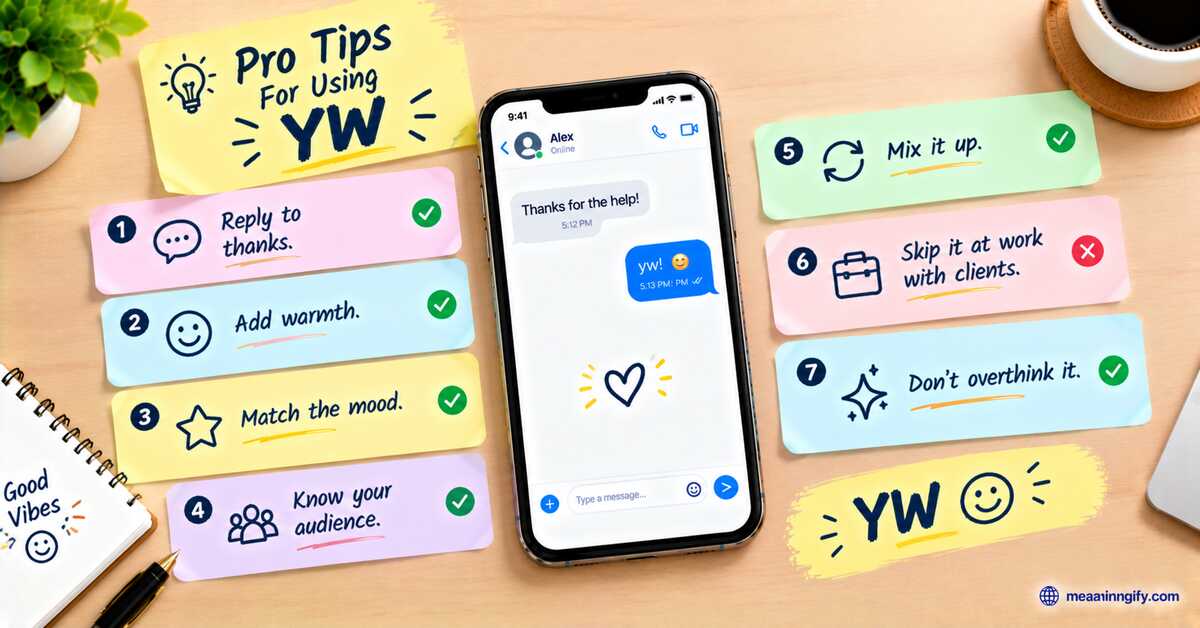
- Reply to thanks. YW fits best right after someone thanks you.
- Add warmth. Try “yw!” or “yw 😊” to avoid sounding flat.
- Match the mood. If the favor was big, write a full sentence.
- Know your audience. Use full words with people who prefer formal language.
- Mix it up. Alternate with “np” or “anytime” so your replies don’t feel robotic.
- Skip it at work with clients. Use “You’re welcome” or “Happy to help.”
- Don’t overthink it. In casual chats, a quick YW is perfectly fine.
Final Thoughts
YW means “you’re welcome.” It is a short, friendly reply that keeps casual chats moving.
Use it with friends and in relaxed settings, add a little warmth when the moment calls for it, and write the full phrase in formal messages. If you ever see YW in an unexpected spot, check the context.
Texting language changes quickly, so treat this guide as a current snapshot.
Frequently Asked Questions (FAQ)
What does YW mean in text?
YW means “you’re welcome.” It is a casual reply to someone who thanked you.
Is YW formal or informal?
It is informal. Use “You’re welcome” in professional messages.
What does YW mean on Snapchat or TikTok?
The same thing: “you’re welcome,” used in DMs and comments.
Is YW rude?
No. It can feel brief, so add an emoji or extra words if you want it to sound warmer.
How do I reply to YW?
A simple “thanks again” or a friendly emoji is enough, or just continue the chat.
What is the difference between YW and NP?
YW answers thanks directly, while NP means “no problem” and downplays the favor.
Can YW mean something else?
Very rarely. In almost every text, it means “you’re welcome.”
Can I use YW in an email?
Only in casual emails with people you know well. Otherwise, write it out.


