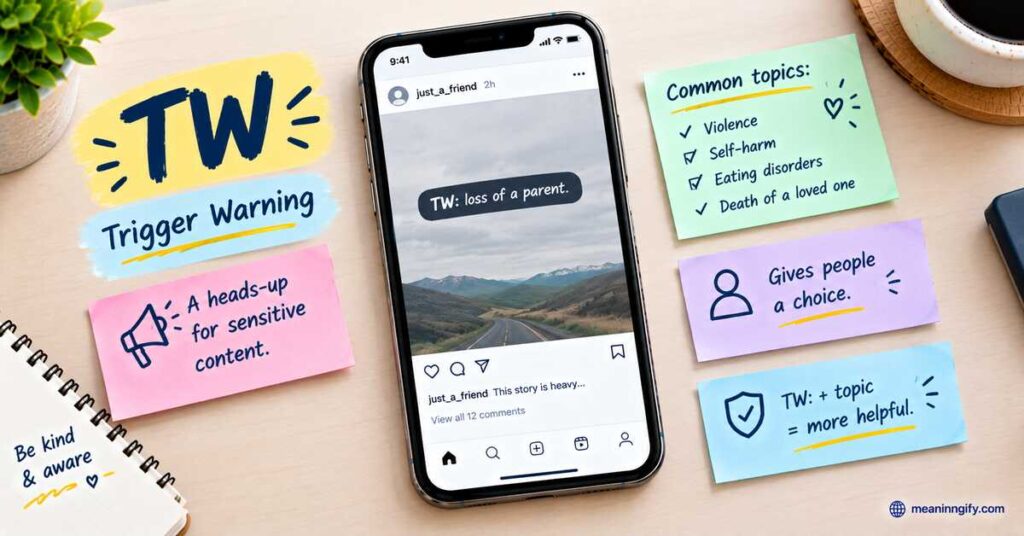

You are scrolling and see a post that starts with “TW: loss of a parent.” Or a friend texts, “tw, this story is heavy.” What do those two letters mean?
In almost every case, TW stands for “trigger warning.” It is a heads-up that sensitive content is coming.
This guide explains the meaning, where people use it, how it compares with similar terms, and how to use it with care. I compared several explainers and kept what they agree on. Where pages list odd extra meanings, I flag them as less common.
What Does TW Mean In Text?
TW means “trigger warning.” It tells readers that the content ahead may upset them, especially people who have been through trauma.
Example: “TW: violence. The next video shows a car crash.”
The label usually comes right before the sensitive post, caption or message. It gives people a choice: keep reading, or skip it.
Simple Meaning (In Case You Still Have Questions)
In plain words: TW = “Heads up, this may be upsetting.”
Think of it like a sign on a door that says “loud noise inside.” You are not told to stay out. You are just told what to expect.
A good TW also names the topic, such as:
- TW: violence
- TW: eating disorders
- TW: self-harm
- TW: death of a loved one
Writing only “TW” without a topic is less helpful, because readers can’t tell what is coming.
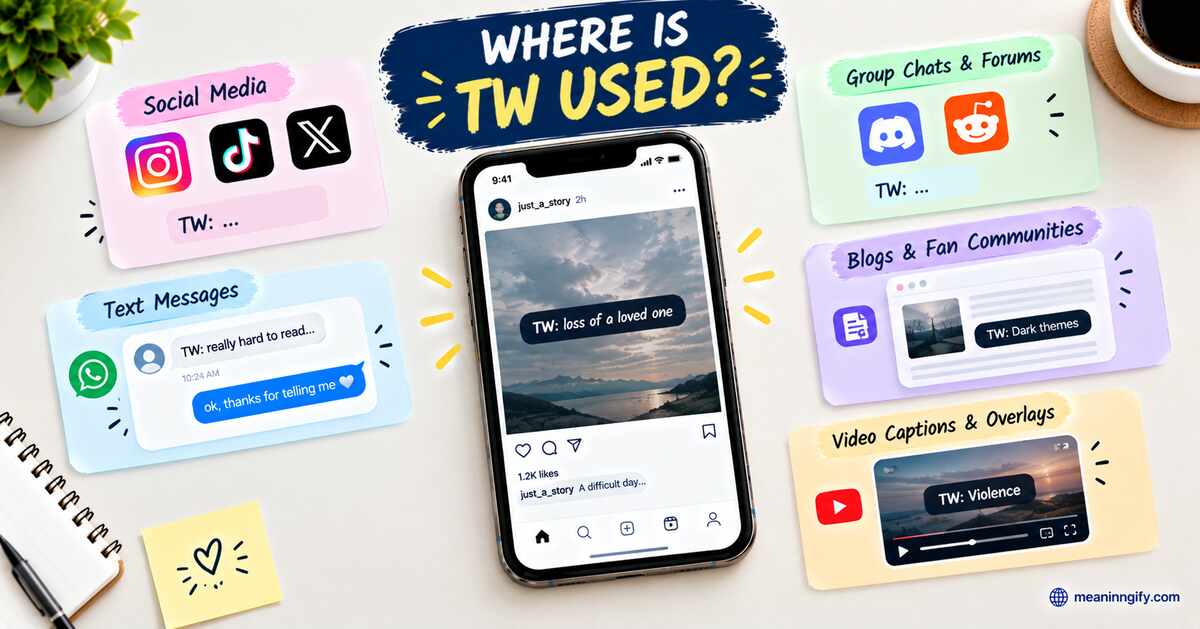
Where Is TW Used?
You will see TW in many online spaces:
- Social media posts: Instagram, TikTok and X (Twitter)
- Text messages: when someone shares hard news or a heavy story
- Group chats and forums: such as Discord or Reddit threads
- Blogs and fan communities: before stories with dark themes
- Video captions and overlays: a quick text frame at the start
Brandwatch’s explainer on trigger warnings notes that TW often appears as labels like “TW: Violence” on posts across these platforms.
Why Do People Use TW?
People add TW for a few good reasons:
- Care. It shows respect for readers who may have painful memories.
- Choice. Readers can decide when they feel ready.
- Preparation. A warning softens the shock of sudden content.
- Community norms. Many online groups expect it.
- Speed. Two letters take little space on a caption or text.
As one explainer puts it, trauma survivors benefit from the heads-up because sudden reminders can cause distress.
Read More : IKRR Meaning In Chat: What It Really Means And Why It’s Viral 2026
Real-Life Examples Of TW In Action
| Situation | Example | Why TW helps |
|---|---|---|
| Social post | “TW: car accident. My story below.” | Warns before a hard story |
| TikTok caption | “TW: self-harm mention” | Lets viewers scroll past |
| Text to a friend | “tw, this is about my breakup” | Signals an emotional message |
| Book review | “TW: abuse, discussed in chapter 5” | Helps readers prepare |
| Forum thread | “TW: eating disorders” | Protects sensitive members |
A few more:
- “TW: loud noises in this clip.”
- “TW // spiders.” (some people use it for phobias too)
- “tw: death, skip if you need to.”
TW vs Similar Terms — What’s The Difference?
| Term | Meaning | Use | Example |
|---|---|---|---|
| TW | Trigger warning | Trauma-related topics | “TW: assault” |
| CW | Content warning | Broader, any sensitive content | “CW: spoilers” |
| NSFW | Not safe for work | Adult or explicit content | “NSFW: nudity” |
| Spoiler alert | Plot reveal ahead | Entertainment | “Spoiler: ending” |
| Viewer discretion | Watch with caution | Videos and TV | “Viewer discretion advised” |
The main difference is TW vs CW. Explainers describe CW as the wider umbrella term, while TW is tied more closely to trauma. In practice, many people use them almost interchangeably, and some creators now prefer CW for most posts.
When Should You Use TW?
Use TW when:
- You are sharing content about trauma, violence, abuse, self-harm or death
- You are posting graphic or emotionally heavy material
- You are texting someone about a heavy topic and want to be gentle
- The community you are in expects warnings
How to do it well:
- Put it first. Place the warning before the content, not after.
- Be specific. “TW: violence” is clearer than “TW.”
- Keep it short. A few words are enough.
- Add space. A line break before the content helps people stop reading.
If you or someone you know is in crisis, a TW is not enough. Reach out to a trusted person or a local support service.

Common Misunderstandings About TW
“TW always means trigger warning.” Mostly yes, but not always. Some pages list other meanings, such as Twitter, “two,” or “transgender women” in community discussions. Check the context.
“A TW is censorship.” No. It does not hide or remove anything. It just labels it.
“TW and CW are identical.” They overlap, but CW is broader.
“Writing TW is enough.” Not really. Naming the topic helps people decide.
“TW is only for serious trauma.” Many people also use it for phobias or sensitive topics. Use your judgment and respect the group’s norms.
“It is slang for something edgy.” Some pages hype TW as a secret or scandalous term. That is not accurate. It is a courtesy label.
Pro Tips For Using TW The Right Way
- Lead with it. Always place the warning at the start.
- Name the trigger. Use short labels like “TW: violence.”
- Use CW when unsure. It works for a wide range of topics.
- Don’t hide the label. Make it easy to see.
- Add alt text or captions. Screen reader users should also get the warning.
- Respect the reader. Don’t use TW as a joke or for clickbait.
- Follow community rules. Some groups have standard formats.

Final Thoughts
TW stands for “trigger warning.” It is a short, caring heads-up that lets people choose whether to read sensitive content.
Use it before heavy topics, name the subject clearly, and consider CW when the topic is broader. If you see TW in an unusual setting, check the context in case it means something else.
Online language keeps changing, so treat this guide as a snapshot, not a rulebook.
FAQ: What Does TW Mean In Text?
What does TW mean in text?
TW means “trigger warning,” a heads-up that content may be upsetting.
What does TW mean on TikTok?
It tells viewers that the video may include sensitive topics like violence or self-harm.
What is the difference between TW and CW?
TW refers to trauma-related content, while CW (content warning) is a broader label.
Is TW the same as NSFW?
No. NSFW refers to explicit content, while TW warns about emotionally distressing topics.
How do I write a TW?
Start with “TW:” then name the topic, like “TW: violence,” before the content.
Can TW mean something else?
Yes, rarely. Depending on context, it may mean Twitter, “two,” or other terms.
Do I need a TW for every sensitive post?
It is good practice for heavy topics, especially when your community expects it.
Is using TW a sign of weakness?
No. It is a courtesy that helps people manage their own wellbeing.